What if AS Labruna’s EFOY was the perfect fit for your motorhome?
AS Labruna has envisioned EFOY methanol fuel cells as zero-emission power dispensers for recharging motorhome batteries
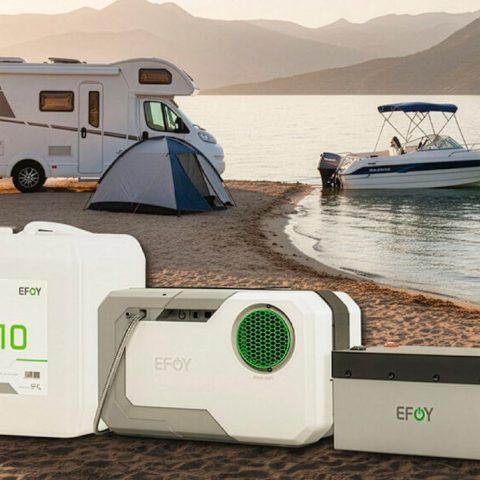
The beginning of the year is a harbinger of good intentions, and AS Labruna’s EFOY is certainly one of them. We came across a concise and effective post on a social media page and felt it was worth sharing. They wrote: “AS Labruna’s EFOY recharges all common 12V or 24V battery types fully automatically in a reliable, quiet, and eco-friendly manner. Whether it’s for a motorhome, a boat, a garden shed, or a cabin, you decide where to use your EFOY. The EFOY generates electricity in an environmentally friendly way. Through a chemical process, it produces only waste heat and water vapor with a small amount of CO2 alongside electricity. Therefore, the EFOY can be safely installed indoors without any issues.”
AS Labruna Boards the Motorhome with EFOY
We have written extensively about methanol and hydrogen fuel cells, often linking these technologies to the prolific experimentation of Massimo Labruna, CEO of AS Labruna. However, we hadn’t yet considered an unusual application for these pages, yet one that is perfectly logical and functional: the motorhome.
Onboard utilities are demanding and place a heavy load on the service battery. This is where a fuel cell generator can intervene virtuously. For the fortunate few who might park their motorhome at the yacht club where their small craft is moored, the synergy would be truly optimal.
Back in 2022, Massimo Labruna shared his first experience with the vessel named Futura: “The boat is equipped with two electric motors, a buffer battery pack, and hydrogen fuel cells that recharge the batteries. To recap the architecture in detail: there are two 6 kW outboards, while the battery pack provides just 5 kW. Thus, against an installed power of 12 kW, the battery pack capacity is 5 kWh. The 2 kW fuel cells can operate for about 10 hours, thanks to the onboard hydrogen cylinders, which contain 30 liters on the anchored model.
Essentially, I have stored 20 kWh of energy in addition to the 5 kWh from the buffer batteries, providing significant range and overcoming the most critical limitation of fully electric power. To increase range otherwise, one would need to add more battery packs, thereby increasing weight and costs, as the boat would travel slower and consume significantly more to achieve the same performance. There is a threshold that cannot be crossed. In this system, the fuel cells act as a range extender, allowing for greater autonomy by performing the supplementary role of generators in series hybrids.“