Direct Current Experience Center
We visited the Direct Current Experience Center in the Netherlands, where we got hands-on experience with the efforts of CurrentOS Foundation members—including Schneider Electric, ABB, and Siemens—to accelerate the transition to DC technology
Fiat Lux (Let there be light), the Latins used to say. An invocation that feels more relevant than ever—especially in light of today’s increasingly demanding electrical loads. Artificial intelligence and data centres, together with the emerging electrification of transportation, are placing growing pressure on the stability of power grids.
To raise awareness of this phenomenon, the Current/OS Foundation welcomed us into its operational centre near Amsterdam’s Schiphol Airport. Current/OS is dedicated to promoting the standardization and harmonization of direct current (DC) technology. We are talking about a relatively recent DC approach, still lacking consolidated standards—unlike alternating current (AC), which has around 150 years of history and ultimately prevailed in the 19th-century “War of the Currents.”
How to Push on Direct Current Technology?
The goal of Current/OS—supported by a strong coalition of more than 120 companies, including Schneider Electric, ABB, Siemens, Carrier and Daikin—is to define the standards required to harmonize the use of direct current in specific applications. Members of the Current/OS technical committee contribute expertise drawn from standardization bodies, ensuring that the technical specifications developed are suited to the integration of DC within systems and architectures.
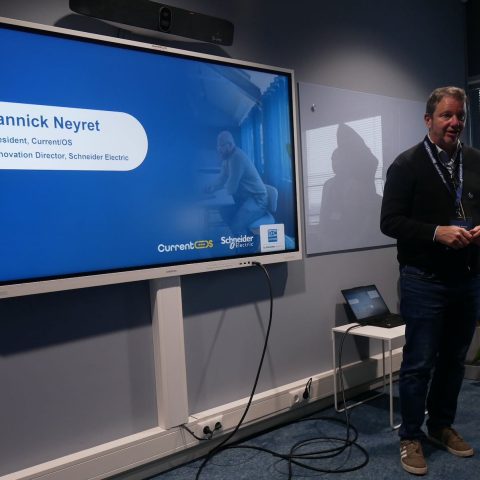
Yannick Neyret, President of the Foundation (on the main photo), challenged us with a question that was as simple as it was disarming: since most electrical systems and applications inherently operate on direct current, why use an AC infrastructure only to convert DC into AC—and then often back again?
The answers emerged through a journey spanning laboratory demonstrations, museum exhibits, and real-world applications (electric vehicle charging, home automation, offices, and services).
The Laboratory Demonstration
Our host at the Direct Current Experience Center was DC Systems, which in 2021 came under the umbrella of Schneider Electric. The focus was on enabling compatibility for non–Current/OS DC loads within a Current/OS ecosystem through a specialized device known as a pre-charger.
Unlike AC systems, DC power systems are particularly sensitive to sudden current spikes—known as inrush current—when devices are switched on. The Current/OS system is designed to detect such spikes and shut down to protect itself.
The demonstration involved:
Two LED lights: one specifically designed to be Current/OS-compatible (from Tritonic, a Current/OS partner), and a standard third-party LED light that was not inherently compatible.
An AC-DC converter designed for Current/OS systems, serving as the power source.
Experiment 1: Compatible load
The Current/OS-compatible LED light was connected directly to the system. It powered on immediately and operated without issues, as it complies with Current/OS specifications and incorporates inrush current management.
Experiment 2: Non-compatible load (without pre-charger)
The standard LED light was connected directly to the system. Upon activation, an error indicator appeared and the system shut down for protection. The non-compatible load generated a current spike that the Current/OS system interpreted as a threat.
Experiment 3: Non-compatible load (with pre-charger)
A pre-charger device, developed by DC Systems, was installed between the non-compatible LED light and the Current/OS system. With the pre-charger in place, the general LED light powered on successfully alongside the compatible one.
The role of the pre-charger
The pre-charger functions as a “soft-start” device. In DC systems, when a load is first activated, a significant surge of current often occurs. The pre-charger gradually ramps up the voltage, smoothing out these spikes and preventing the protective shutdown of the Current/OS system. In practical terms, it allows a non–Current/OS-compliant load to operate within the ecosystem by effectively managing inrush current.
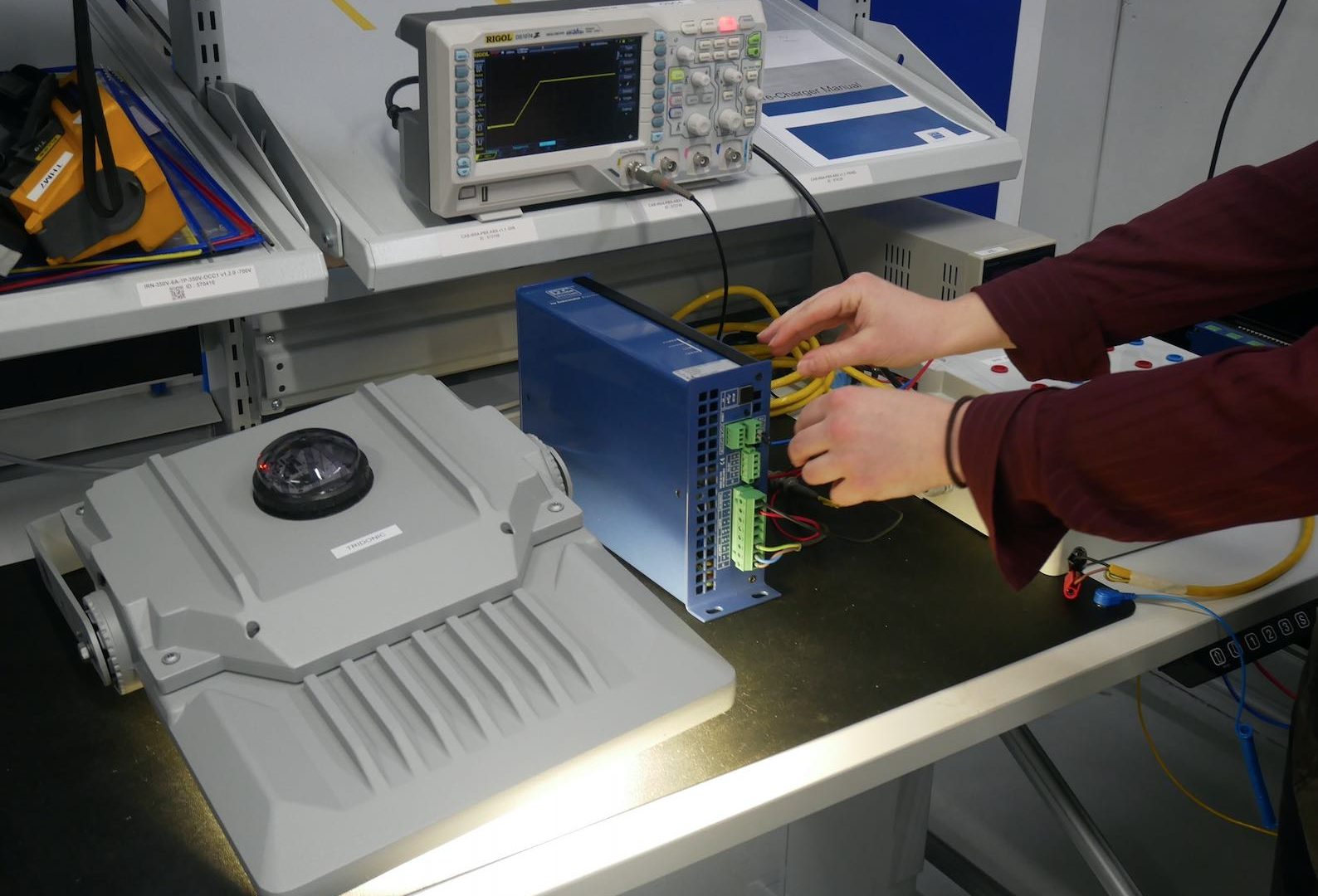
DC Systems (part of Schneider Electric) aims to foster an open ecosystem. The pre-charger enables partners to integrate existing products—even if not natively Current/OS-compatible—without requiring extensive redesign.
While the demonstrated pre-charger was intended for smaller loads (up to 2,100 watts), the technology is scalable, with modules available for significantly higher capacities (for example, up to 30 kW).
In essence, the pre-charger bridges the gap, allowing a broader range of DC devices to be safely and efficiently integrated into Current/OS power distribution systems by addressing the critical issue of inrush current.
Coming Soon
This is just the first chapter in a series of snapshots from our experience at the Direct Current Experience Center. You’ll also find an overview in the next issues of POWERTRAIN International magazine.