A ship is powered by CATL batteries
China’s First All-Electric Passenger is Powered by CATL
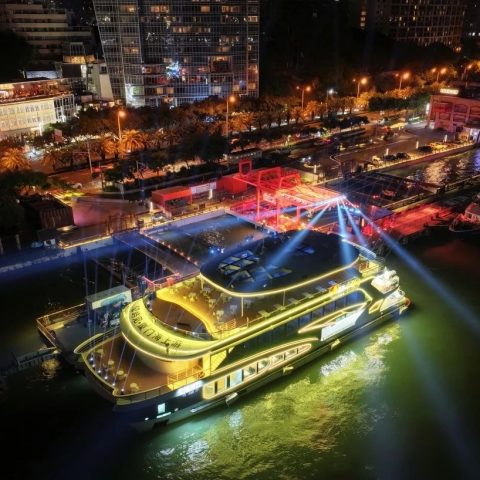
CATL has ventured where resistance to electrification is greatest: marine applications. And we are not talking about just any boat, but a large passenger ship. On July 25, Yujian 77, the first all-electric marine passenger ship in China, jointly developed with CATL, officially set sail in Xiamen Bay. Equipped with CATL’s marine battery system, the vessel not only offers tourists a zero-emission, low-noise and high-quality marine tourism experience, but also verifies the feasibility of pure electric technology in offshore navigation.
CATL CTP and CCS for the passengers ship
The CATL marine battery system equipped in Yujian 77 innovatively adopts both CTP (cell-to-pack), and integrated CCS (combined charging system) technologies, achieving a battery pack energy density of more than 140Wh/kg. This system provides Yujian 77 with a power capacity of 3,918kWh, achieving a pure-electric cruising range of 100km, which is sufficient to support four consecutive nighttime tour routes across Xiamen Bay. In terms of safety, the battery pack adopts NP (non-propagation) technology, providing cell-level resistance to thermal runaway. It also reaches the IP68 rating and can withstand a salt spray test for up to 1,296 hours, ensuring stable operation even under challenging marine conditions.
In addition, after its deployment, Yujian 77 is expected to reduce annual fuel consumption by nearly 250 tons and cut carbon dioxide emissions by over 400 tons, equivalent to the carbon sequestration capacity of planting over 20,000 trees.
A long list of classification societies
As China’s first pure-electric marine passenger ship classified by the China Classification Society (CCS), the CATL marine battery in Yujian 77 has also secured certification from leading international classification organizations such as Bureau Veritas (BV), American Bureau of Shipping (ABS), and Det Norske Veritas (DNV).