BAM, HZB and HU are investigating sodium batteries
Berlin Battery Lab: BAM, HZB and HU are conducting joint research on sodium batteries
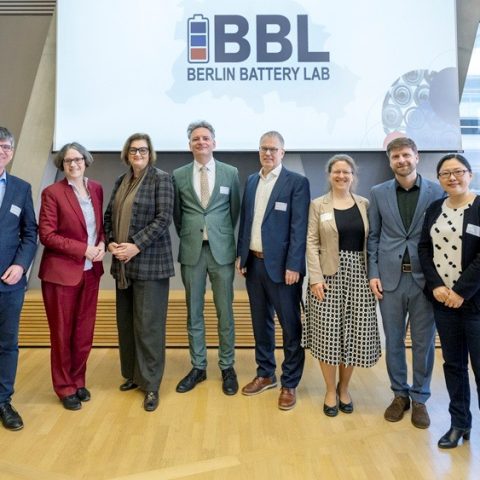
The buzz around sodium batteries is growing louder, and Germany’s BAM (The Federal Institute for Materials Research and Testing) has no intention of being caught off guard. In these pages, we have already covered the inevitable Chinese players — CATL for first— as well as TaiSan, BASF and NGK. Now the time has come: BAM, the Helmholtz-Zentrum Berlin (HZB) and Humboldt-Universität zu Berlin (HU) have jointly inaugurated the Berlin Battery Lab (BBL).
The Berlin Battery Lab, BAM and the testing of Sodium Batteries
The Berlin Battery Lab functions as a central platform that strategically integrates the complementary expertise of the participating institutions. BAM contributes internationally recognized expertise in battery safety and the development of innovative energy materials. HU is one of the leading academic research institutions in the field of sodium-ion batteries. HZB provides long-standing experience in lithium-sulfur battery research and operates BESSY II, one of the world’s most powerful X-ray sources for studying battery-chemical processes.
At the inauguration, the Berlin Senator for Science, Health and Care Ina Czyborra, stated: “The Berlin Battery Lab illustrates Berlin’s strength in strategically bringing together top-level research and technological needs – through close cooperation between three outstanding partners and a short path from research to application. Battery research is a key technology on the High-Tech Agenda. The Berlin Battery Lab strengthens Germany’s technological sovereignty by reducing dependence on critical raw materials and increasing the resilience of key value chains. These national challenges can only be met through close collaboration – with a clear joint commitment from the federal and state governments, including appropriate funding instruments. The State of Berlin is pleased to support this goal and is providing the Berlin Battery Lab with an additional €2.4 million from the European Regional Development Fund (ERDF) between 2026 and 2028.“
Ulrich Panne, President of BAM: “Many new battery technologies are being developed in Germany, but they are not reaching application quickly enough. This is exactly where the Berlin Battery Lab makes a difference: here in Berlin, we bring together research, development and cell manufacturing while integrating safety considerations and regulatory requirements to help transfer sustainable innovations into practice.”
Julia von Blumenthal, President of HU: “Batteries are a key technology for the sustainable energy supply of the future. The Berlin Battery Lab consolidates the expertise of three outstanding research institutions in this field at the Berlin location. The Berlin Battery Lab will span the entire research chain, facilitate collaboration with industry and accelerate the processes leading to practical application. It will create innovations and thus make an important contribution to addressing one of the central challenges of our time.”
Bernd Rech, Scientific Director of HZB: “At the Berlin Battery Lab, we combine our diverse competencies to accelerate development and technology transfer to industry. At HZB, we are establishing a new pouch-cell laboratory for sodium-ion batteries and providing state-of-the-art characterization methods at BESSY II.”
During the inauguration, Philipp Adelhelm (HU), one of the three scientific directors of the Berlin Battery Lab alongside Tim Patrick Fellinger (BAM) and Yan Lu (HZB), received a Wilhelm-Ostwald Fellowship from BAM. Named after Nobel laureate Wilhelm Ostwald, the award recognizes Adelhelm’s contributions to the physical chemistry of batteries, particularly in the field of sodium-ion technology. The fellowship enables in-depth scientific collaboration between HU and BAM and strengthens interdisciplinary exchange within the Berlin Battery Lab.