Schaeffler to recycle electric axle drives
Schaeffler set to head ReDriveS research project for sustainable and circular use of electric axle drives
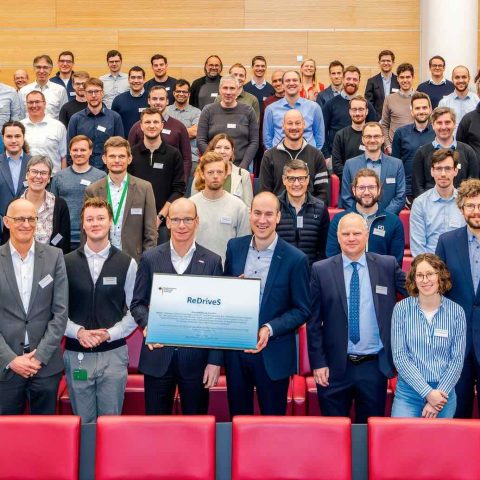
Schaeffler has no taste for the mundane, as evidenced by its role as lead partner in the ReDriveS project, funded by the German Federal Ministry for Economic Affairs. While the term ‘recycling’ in the context of ‘batteries’ usually refers to the disposal and reuse of rare earths in the battery itself and the device as a whole, often referred to as a ‘second life’ in stationary applications, Schaeffler is exploring a different frontier.
The Electric Axle in the Schaeffeler ‘s View
In this case, the goal is to develop an industrial, automated, scalable, and non-destructive recycling concept for electric axles.
Schaeffler is coordinating the lighthouse project ReDriveS – funded by the German Federal Ministry for Economic Affairs and Energy – with 25 partners from industry, SMEs, and academia. The objective of the project is to develop an industrial, automated, and scalable recycling concept for electric axle drive systems – from non-destructive disassembly to innovative recycling processes and digital data use.
ReDriveS will therefore not just provide a technological advantage for complying with statutory recycling requirements but will also ensure future cost-effective access to high-value raw materials like rare earths. ReDriveS has a project volume of over €25 million, with total funding exceeding €16 million. The project will run for a period of 36 months and will play a key role in driving sustainable transformation in the mobility and automotive industry.
Prof. Dr. Tim Hosenfeldt, Head of Central Technologies at Schaeffler AG, says: “With ReDriveS, we are launching a key project for the circular economy in electric mobility as consortium leader, together with the German Federal Ministry for Economic Affairs and Energy and strong partners. Our goal is to make electric axle drives significantly more resource-efficient through digital twins, automated disassembly, and high-quality recycling – thereby securing raw materials and supply chains, reducing CO₂ emissions, and strengthening Germany as a location overall.”
Rare earths in magnets, as well as copper, aluminum, steel, and electronic components, play an especially important role. The scalable disassembly concept will support the repair of the axle drive, the reuse of subcomponents, or their recycling. An evaluation matrix processes information about the condition and geometry of the respective electric axle drives and will be able to derive economic disassembly scenarios for the disassembly robot. To this end, Schaeffler’s second key task alongside project management is to develop a demonstrator linked to a digital twin that collects and processes data over the entire lifecycle of an electric axle drive.
Depending on the condition of the electric axle drive components, the electric axle drive can be dismantled only into its main units (typically: motor, inverter, transmission) or broken down to component level (for recycling). The generic digital twin created in the project can be used independently of manufacturer.
Regarding further market development of electric axle drives as a cornerstone of sustainable mobility, ReDriveS will also develop new data-based business models for axle drives. The digital twin is an important prerequisite for this as well.
From the automotive industry to the NRMM?
With its combined focus on automation, digitalization, and the circular economy, ReDriveS exemplifies the transformation in the German automotive industry towards sustainable, data-driven and resource-efficient production systems. The final outcomes of the project are to be transferred into industrial applications and harnessed as an industry solution for OEMs, suppliers, and recyclers.