Yanmar Green Challenge 2050
Yanmar Compact Equipment is committed to adopting more sustainable practices – and to helping its customers and users of its products to do the same. The company, part of the Yanmar Group, is committed to creating a sustainable future and, along with its fellow Group companies, recently launched the Yanmar Green Challenge 2050 to help achieve this aim.
Yanmar Compact Equipment is committed to adopting more sustainable practices – and to helping its customers and users of its products to do the same. The company, part of the Yanmar Group, is committed to creating a sustainable future and, along with its fellow Group companies, recently launched the Yanmar Green Challenge 2050 to help achieve this aim.
The challenge commits the entire company to be free from greenhouse gas emissions by 2050. To achieve that, action needs to happen today. These actions can be divided into three areas – to reduce the greenhouse gasses the company makes in its own operations, to maximise the reuse of resources – and to help its customers also achieve these same objectives.
Commenting on the commitment, Yanmar CE’s CEO Giuliano Parodi said: “The Yanmar Green Challenge 2050 starts with us. If we all play our part and show our commitment, then we will be in a position to convince our customers and business partners to follow our lead and reduce their greenhouse gas emissions too. It is important that we take the lead and show what is possible.”
Yanmar Green Challenge in practice
The Green Challenge is pulling together individual initiatives that were already ongoing into a cohesive “big idea”. To make Yanmar CE’s manufacturing cleaner, the company is reducing its energy use – through more effective insulation of its buildings and fitting extensive solar panels on the roofs of factories. Sourcing green energy and increasing energy independence will lower Yanmar’s carbon footprint – and also reduce overheads. This process will take time to complete, but the direction of travel is clear.
Progress will be redoubled when it comes to product innovation. The process of making engines even more fuel efficient continues, and Yanmar has recently unveiled an all-electric range of compact excavator, compact wheel loader and compact tracked carrier. New tech is also being considered – particularly the potential of hydrogen to power the company’s machines. The electrification of machines brings tangible benefits for the climate – but for customers too. They are quieter, cleaner and require less maintenance – boosting uptime and productivity.
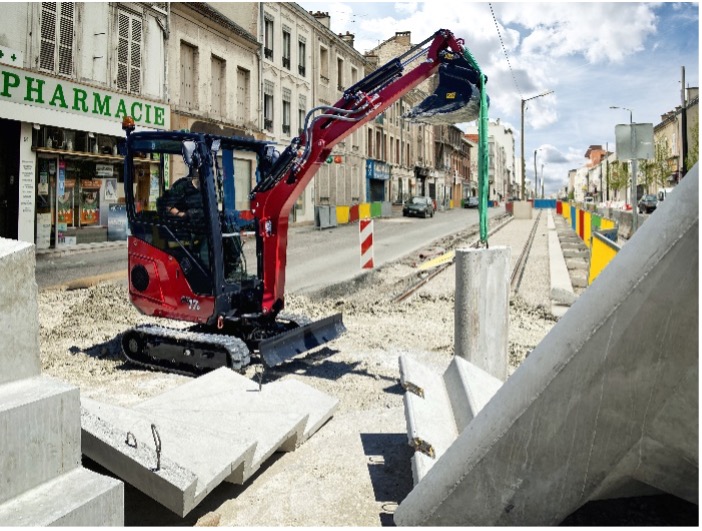
The materials Yanmar makes its products from is also under constant scrutiny. Today, machines are made from steel, plastics, rubber etc – and these aren’t easily substituted for greener materials. But as cleaner alternatives appear they will be embraced, and Yanmar is working hard to find smarter ways to ‘reduce, reuse and recycle’ materials and components.
Business benefits of going Green
Doing good for the climate will also have associated business benefits. The Green Challenge will help strengthen the Yanmar brand compared to its competitors, help it become more attractive to investors and attract and retain talent.
This summer’s extreme weather conditions are likely to become commonplace if insufficient action is taken to avert climate change. Environmental legislation will undoubtedly increase, and those companies already advanced in making the circular economy will benefit.
“Meeting the Green Challenge 2050 is not just about our products – it’s also about our mindset,” concludes Yanmar CE CEO Giuliano Parodi. “Doing nothing is not an option, so let’s all start today by looking for ways to be more sustainable in our everyday lives.”