Battery Technology and Energy Storage According to Morningstar DBRS
Morningstar DBRS introduces us to a broad and bold vision of BESS market. China remains the dominant supply chain player, while North America and Europe are growing markets because of localization, recycling investment, and energy-security policies
When you mention batteries, you mean storage. This is a crucial crossroads for the energy transition. Morningstar DBRS provides an analysis of this technological support in terms of market, financing dynamics, and credit considerations.
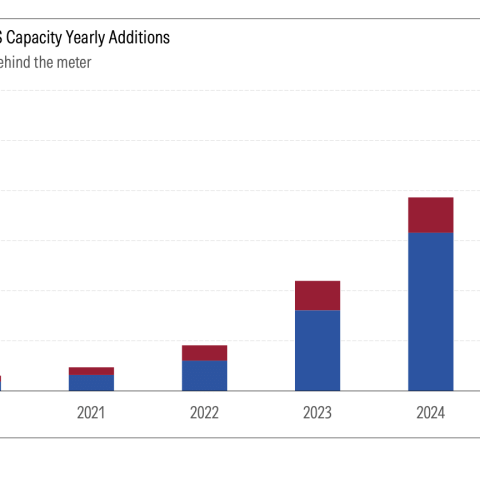
The global battery storage market is expanding rapidly as electricity systems integrate increasing volumes of renewable generation, with yearly new capacity installations increasing to 108 gigawatts (GW) in 2025 from 5 GW in 2020 (Exhibit 1).
Battery and Storage: A Chinese Story
China is the largest battery storage market in the world, with leading positions in battery storage deployment, cell production, material processing, and equipment manufacturing. The United States, meanwhile, is the fastest-growing major storage market outside China, supported by renewable energy expansion, grid modernization requirements, and policy incentives designed to encourage domestic manufacturing and deployment. Europe continues to experience strong growth as countries pursue decarbonization objectives and integrate expanding renewable generation capacity, while Australia, the Middle East, India, and parts of Southeast Asia are becoming increasingly important growth markets. The battery supply chain is complex.
Mineral Production. Who and Where
Upstream mineral production is concentrated among a few countries: Australia, Chile, and Argentina are major sources of lithium, while the Democratic Republic of Congo accounts for a substantial share of global cobalt production. Graphite, another critical battery input, is heavily concentrated in China. The intermediate processing stage is one of the most significant areas of Chinese dominance. China has established leading positions in refining lithium and cobalt, processing graphite, and manufacturing key battery materials such as cathodes and anodes. This control over midstream processing has enabled Chinese firms to achieve substantial economies of scale and cost advantages.
We view large, integrated manufacturers as benefiting from scale and supply security that comes from supply chain concentration, while dependence on a limited number of critical mineral sources exposes the industry to commodity price volatility, geopolitical tensions, and trade restrictions. We anticipate that the ability to secure raw materials and maintain cost competitiveness will remain a key determinant of credit quality across the sector.
Business Models and Financing Structures
Battery storage projects depend on a variety of revenue streams. In regulated markets, storage assets often generate revenues through long-term contracts with utilities or grid operators. These arrangements may include capacity payments, availability payments, or contracted ancillary services revenues, providing relatively stable and predictable cash flows. In more liberalized electricity markets, however, battery storage projects increasingly rely on merchant business models. Revenue sources may include energy arbitrage, whereby electricity is purchased during low-price periods and sold during periods of higher demand, as well as participation in ancillary services markets such as frequency regulation and reserve capacity. While merchant exposure can offer attractive returns, it also introduces greater earnings volatility and increases sensitivity to electricity market conditions.
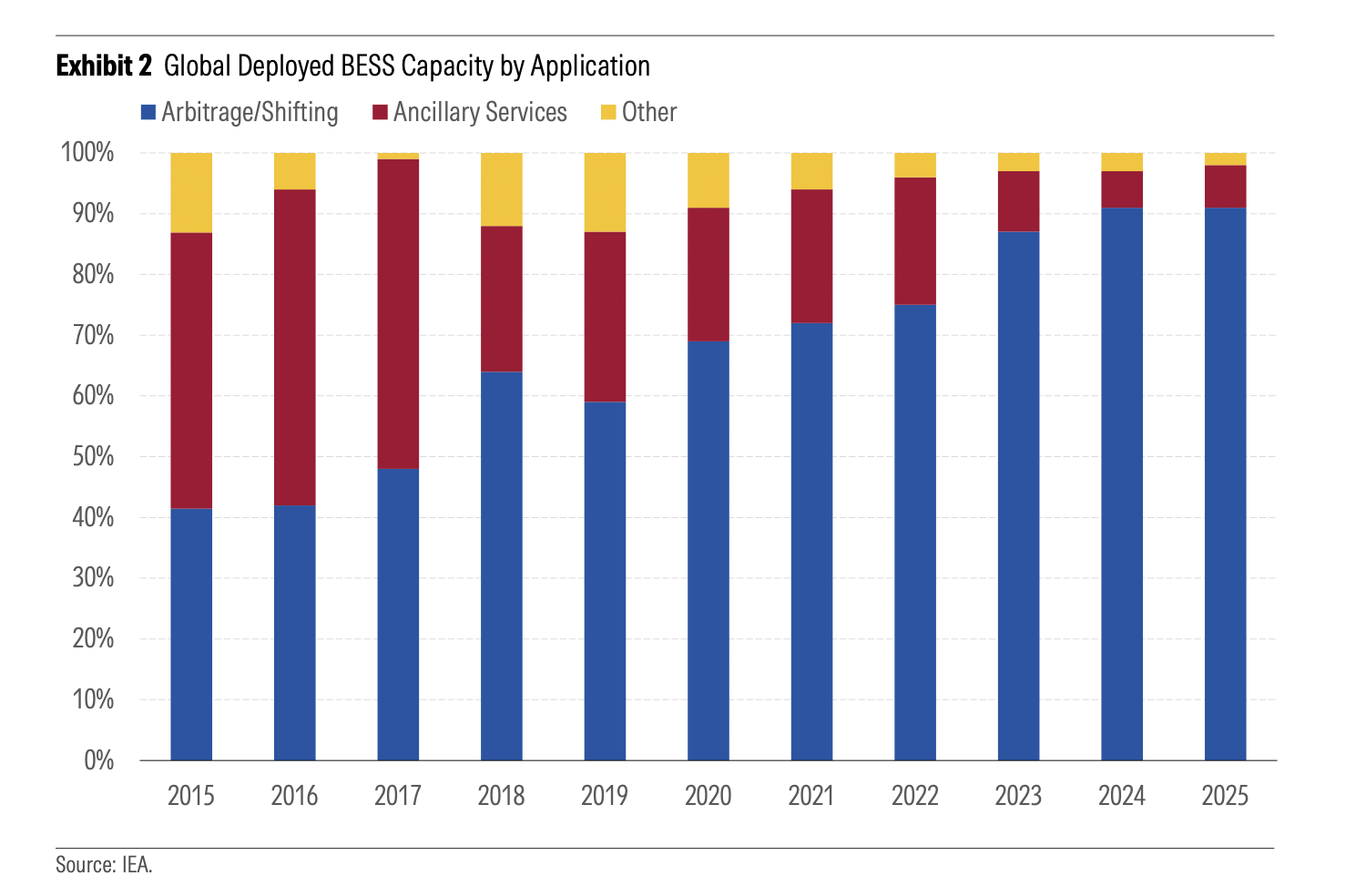
Early market applications for battery storage tend to be focused more on ancillary services and frequency regulation applications because of the initial limited battery capacity penetration. As the market evolves, revenue gradually becomes dominated by energy arbitrage applications (Exhibit 2). Moreover, hybrid renewable projects that combine solar or wind generation with battery storage are becoming an increasingly important sector of the market, as they enhance renewable asset utilization, improve dispatchability, and increase revenue stability by shifting energy delivery toward higher-value periods. As renewable penetration rises, co-located storage is expected to become a standard feature of many new renewable developments.
Unsurprisingly, financing structures have evolved alongside the growth of the asset class. Early deployments were often financed through corporate balance sheets, primarily by utilities or large energy companies. Now that the technology has matured, project finance structures have become increasingly common, particularly for assets supported by contracted revenues. Infrastructure funds, pension funds, and sovereign wealth funds have also become active participants, attracted by the sector’s long-term growth prospects and infrastructure characteristics. In the United States, tax incentives and tax-equity financing mechanisms have further supported investment activity, while green bonds and sustainability-linked financing instruments have become common funding tools globally.
Key analytical considerations increasingly include revenue visibility, contract duration, counterparty strength, battery degradation assumptions, warranty structures, and the long-term competitiveness of the underlying technology. Projects with stable contracted revenues generally exhibit stronger credit characteristics than those relying heavily on merchant market exposure. Capacity-based contracts, where a project is compensated for being available to be dispatched as required, are generally the most creditworthy form of contract but may limit the upside revenue potential often sought by equity investors. Contracts that depend on dispatch or merchant revenues offer more upside potential but require a thorough understanding of the power dynamics of the region where the battery project is installed.
Technology Approaches
The battery industry remains highly concentrated, particularly at the cell-manufacturing level. Chinese manufacturer Contemporary Amperex Technology Co., Limited (CATL) is the global market leader, with a diversified technology portfolio that includes lithium iron phosphate (LFP), nickel-based chemistries, and emerging sodium-ion technologies. BYD Company Limited (BYD) has established itself as the second-largest battery manufacturer off the back of its vertically integrated business model that includes battery production, electric vehicles, and energy storage systems. LG Energy Solution Ltd. (LG Energy Solution); Samsung SDI Co, Ltd. (Samsung SDI); and Panasonic Holdings Corporation (Panasonic) remain important participants, particularly in premium and automotive-focused applications, while Chinese firms such as CALB Group Co., Ltd. (CALB); Gotion High-Tech Co., Ltd. (Gotion); EVE Energy Co., Ltd; and SVOLT Energy Technology Co., Ltd. continue to gain market share.
Major Battery Manufacturers Company Approximate Global Position Technology Focus CATL Global leader (~35% to 40% EV battery market share) LFP, NMC, sodium-ion BYD Number 2 globally (~15% to 20%) Blade Battery, LFP LG Energy Solution Top 3 CALB Growing Chinese player LFP/NMC Gotion Expanding globally LFP-focused Samsung SDI Premium applications High-energy density NMC and advanced chemistries Source: International Energy Agency (IEA), Global EV Outlook (2024, 2025, 2026); IEA, Status of Battery Demand and Supply (2024); McKinsey & Company, Battery Insights; company annual reports and investor presentations from CATL, BYD, LG Energy Solution, Samsung SDI, Panasonic Energy, CALB, and Gotion. Panasonic Automotive focused High-performance cells The market for BESS integration is similarly becoming concentrated among a handful of global leaders. Chinese companies once again have rapidly expanded their market positions, benefiting from access to low-cost cells and integrated supply chains. BYD and Tesla Energy Operations, Inc. (Tesla Energy) are among the largest global system integrators, while Sungrow Power Supply Co., Ltd. (Sungrow), CATL, CRRC Zhuzhou, and Huawei Technologies Co., Ltd. (Huawei) have established meaningful market shares. Fluence Energy, Inc. (Fluence) remains one of the few significant Western storage integrators with global reach.
LFP & NMC
Technologically, the industry is increasingly converging around LFP chemistry for stationary storage applications because of its cost advantage and safety characteristics. Nickel manganese cobalt (NMC) batteries remain relevant in applications where higher energy density is required, particularly in certain automotive segments. Looking ahead, sodium-ion batteries may offer a lower-cost alternative that reduces dependence on critical minerals such as lithium and cobalt, while solid-state technologies have the potential to improve safety and energy density, although commercial deployment remains some distance away. In our view, technological disruption remains a long-term credit consideration, but lithium-ion technology is likely to maintain its dominant position through the medium term.
China’s Industrial Policy and Strategic Positioning
China’s leadership in battery manufacturing and supply chains is the result of a sustained and coordinated industrial strategy implemented over more than two decades. Government support has included direct subsidies, preferential financing, support for electric vehicle adoption, incentives for domestic manufacturing, and strategic investments across the entire value chain. Rather than focusing solely on battery production, policymakers have targeted the complete ecosystem, including mining, refining, materials processing, cell production and downstream applications.
More recently, energy storage has been promoted as a key enabler of renewable energy and power system flexibility, with both national and provincial governments supporting investment and adoption. However, China’s success has prompted policy responses from other major economies. In the United States, government programs seek to encourage domestic battery production and reduce dependence on foreign supply chains. Europe has pursued similar objectives through initiatives aimed at promoting local manufacturing capacity, strategic autonomy, and critical mineral diversification. While these policies may stimulate investment, they are also likely to increase industry capital expenditures and potentially lead to excess capacity in some segments of the value chain. In our view, China’s dominance presents a mixed picture. Large Chinese manufacturers benefit from scale, integrated supply chains and strong competitive positions.
However, rapid capacity expansion has intensified competition across parts of the battery value chain, contributing to falling prices and margin pressure for some producers. Increasing geopolitical tensions, trade restrictions, localization requirements, and tariff measures may create uncertainty regarding future market access. At the same time, Western manufacturers face the challenge of achieving comparable scale and cost competitiveness while building alternative supply chains. As a result, the industry is likely to experience a degree of regionalization, with parallel supply chains emerging across different geopolitical blocs.
Morningstar DBRS Conclusion
BESS has become a foundational technology for the global energy transition. Strong demand growth looks set to continue as renewable energy deployment accelerates and electricity systems require greater flexibility and resilience. However, the sector’s competitive structure remains heavily influenced by China’s dominant position across manufacturing and supply chains.
We view supply-chain concentration, technology evolution, revenue stability, and geopolitical risk as key credit considerations across the industry. Companies with scale, vertical integration, access to secure raw material supplies, and exposure to contracted revenue streams are best positioned to benefit from sector growth. Conversely, businesses exposed to merchant market volatility, technological disruption, or fragmented supply chains may face increasing credit pressures as the industry matures.
We expect the interaction between industrial policy, technological development, and global trade to remain central to the sector’s long-term credit outlook. Issuer Type Key Opportunities Key Risks Mining/Materials Suppliers Demand growth, strategic pricing power Commodity price cyclicality Battery Manufacturers Volume growth, scale benefits Overcapacity, margin compression, capex burden Utilities Grid flexibility, rate-base growth Technology obsolescence, execution risks IPPs/Renewable Developers Better project economics, better dispatchability Revenue volatility, merchant exposure BESS Integrators Expanding addressable market Performance liabilities Source: Morningstar DBRS Analysis.
BESS Players
- BYD: ~13% estimated global market share – Global leader Vertically integrated battery manufacturing and storage systems.
- Tesla Energy: ~10% estimated global market share. Leading utility-scale storage provider Megapack platform, software integration, project execution.
- Sungrow ~9% estimated global market share. Top global supplier Inverters, PCS technology, integrated BESS solutions.
- CATL ~6% estimated global market share. Major battery-led storage player Manufacturing scale, cell technology leadership.
- CRRC Zhuzhou ~6% estimated global market share. Leading Chinese utility-scale integrator Grid-scale project expertise and domestic market presence.
- Fluence ~4% estimated global market share. Leading independent integrator Energy management software and utility-scale project delivery.
Source: Wood Mackenzie global BESS integrator rankings; BloombergNEF energy storage market reviews; S&P Global Commodity Insights; International Energy Agency (IEA), Batteries and Secure Energy Transitions (2024); International Renewable Energy Agency (IRENA), Energy Storage Overview; company annual reports and investor presentations.
About Morningstar DBRS
Morningstar DBRS is a leading provider of independent credit rating services and opinions for corporate and sovereign entities, financial institutions, and project and structured finance instruments globally. Rating more than 4,500 issuers and 68,000 securities, we are one of the top four credit rating agencies in the world and a market leader in Canada, the U.S., and Europe in multiple asset classes.
How fast is the global battery storage market growing according to the text?
The global battery storage market is expanding very rapidly. Yearly new capacity installations are projected to increase from 5 gigawatts (GW) in 2020 to 108 gigawatts (GW) in 2025.
Why does China dominate the intermediate processing stage of the battery supply chain?
China dominates the midstream processing because it has established leading positions in refining lithium and cobalt, processing graphite, and manufacturing key battery materials like cathodes and anodes. This control allows Chinese firms to achieve substantial economies of scale and cost advantages.
What is the difference between battery storage revenues in regulated markets versus liberalized markets?
In regulated markets, projects generate stable and predictable cash flows through long-term contracts (such as capacity or availability payments). In liberalized markets, they increasingly rely on merchant business models, earning revenue through energy arbitrage and ancillary services, which offers higher potential returns but introduces greater earnings volatility.