AVL Engineering Capabilities Show How Fuell Cells Are a Viable Solution for Data Centers
Stationary fuel cell power becomes credible at system level. SOFC prime power and PEMFC backup power address different operating roles, but both require disciplined requirements engineering, balance-of-plant integration, thermal and electrical design, controls, safety, and validation. AVL connects these workstreams from architecture definition through simulation, detailed engineering, prototype build, testing, and modular scale-up
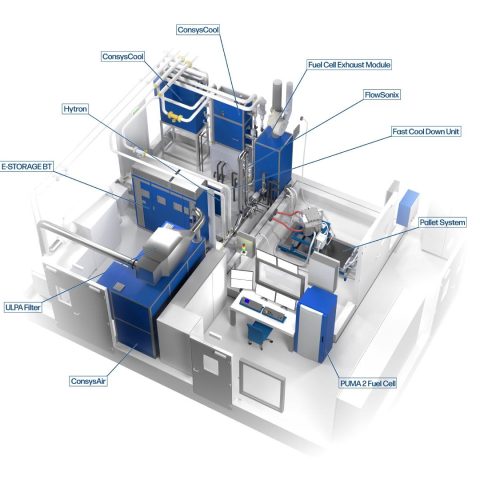
According to AVL, behind-the-meter systems generate electricity directly at the data center, improving access to power and enabling prime power, backup power, energy storage, and controls to be coordinated around site- specific requirements. High efficiency, quiet operation, and limited gas-turbine availability are accelerating interest in solid oxide fuel cell systems for prime power. Proton exchange membrane fuel cells provide a complementary option for fast-starting backup power. Both technologies can offer advantages over internal combustion engines and gas turbines when matched to the required operating profile.
AVL is Able to Translate the Data Center Duty Profile Into a Traceable Fuel Cell System Architecture
AVL starts with the data center duty profile and converts application needs into a traceable system architecture. For SOFC prime power, the requirements baseline covers continuous operation, thermal integration, fuel strategy, balance-of-plant behavior, electrical interfaces, and the relationship between module output and plant demand. For PEMFC backup power, it defines startup and transition logic, stored-energy interaction, cooling and fuel boundaries, control responsibilities, and validation objectives. Model-based systems engineering provides the framework for connecting these requirements across system, subsystem, and component levels.
System and process simulation, computational fluid dynamics, finite element analysis, and robustness analysis then expose operating limits, media-distribution challenges, thermal gradients, pressure losses, structural loads, and expected component deviations. The resulting architecture defines clear interfaces, operating windows, models, and acceptance criteria for stack-module engineering, complete-system integration, and subsequent validation against a common engineering baseline.
The Graz Formula
AVL engineers SOFC stack modules as functional units with a clear focus on thermal performance, media distribution, mechanical robustness, efficiency, and durability. The development process combines stack benchmarking, computational fluid dynamics, finite element simulation, detailed design, assembly, testing, and validation. AVL’s established process enables temperature distribution below 5 °C and uniform media distribution of ±0.2 %. These characteristics support consistent operation across the integrated stacks, maximize module output and efficiency, and help minimize degradation.
Thermal management, structural optimization, sealing, instrumentation, safety support, and maintenance considerations are addressed within the module design rather than treated as separate downstream tasks. AVL also connects module performance with buildability and commercial requirements through demonstrator development, production engineering, assembly, small-scale series manufacturing, cost engineering, design-to-cost, and design-to-manufacture methods.
Integrate Balance of Plant and Controls, then Extend the Architecture to MW Scale
AVL integrates the fuel cell stack or stack module with every function required for reliable operation at both the individual-system and plant level. The scope includes mechanical and electrical balance of plant, thermal management, instrumentation, power electronics, controls, diagnostics, sealing, safety, packaging, and service access. Interfaces are engineered as part of one coordinated system because they determine operating limits and influence overall robustness.
For SOFC prime power, AVL coordinates high-temperature media conditioning, reformate supply, thermal integration, electrical isolation, and continuous-operation strategies.
For PEMFC backup power, the integrated architecture brings together fuel-cell systems, cooling, stored energy, power conversion, controls, and black-start functionality. The same interface discipline supports modular plant development. Repeatable stack modules can be interconnected within a larger balance-of-plant configuration while maintaining defined media, thermal, electrical, and control interfaces. Customers gain a coherent engineering baseline that converts system requirements into integrated hardware and controls, supporting the transition from an initial power unit to a megawatt-scale plant architecture.
A Case Study
A 60 kW solid oxide fuel cell stack module was developed as the building block for a modular prime- power architecture. The project formed part of the IPCEI Hy2Tech initiative and was carried out successfully together with Elcogen. The selected output was appropriate for this development step: sufficiently large to reveal system-level behavior, yet manageable for detailed design, integration, and testing. AVL combined the stack module with balance-of-plant components and evaluated the integrated configuration using hydrogen and natural-gas reformates.
The work addressed media supply, thermal management, electrical integration, instrumentation, controls, and operating strategy as interconnected system functions. The module established the basis for a scalable SOFC architecture. In a final product, multiple 60 kW stack modules can be interconnected with a larger balance-of-plant configuration to achieve the required output. This preserves a repeatable module while allowing plant capacity to grow through system integration. Feasibility studies are evaluating a higher-output stack-module design.
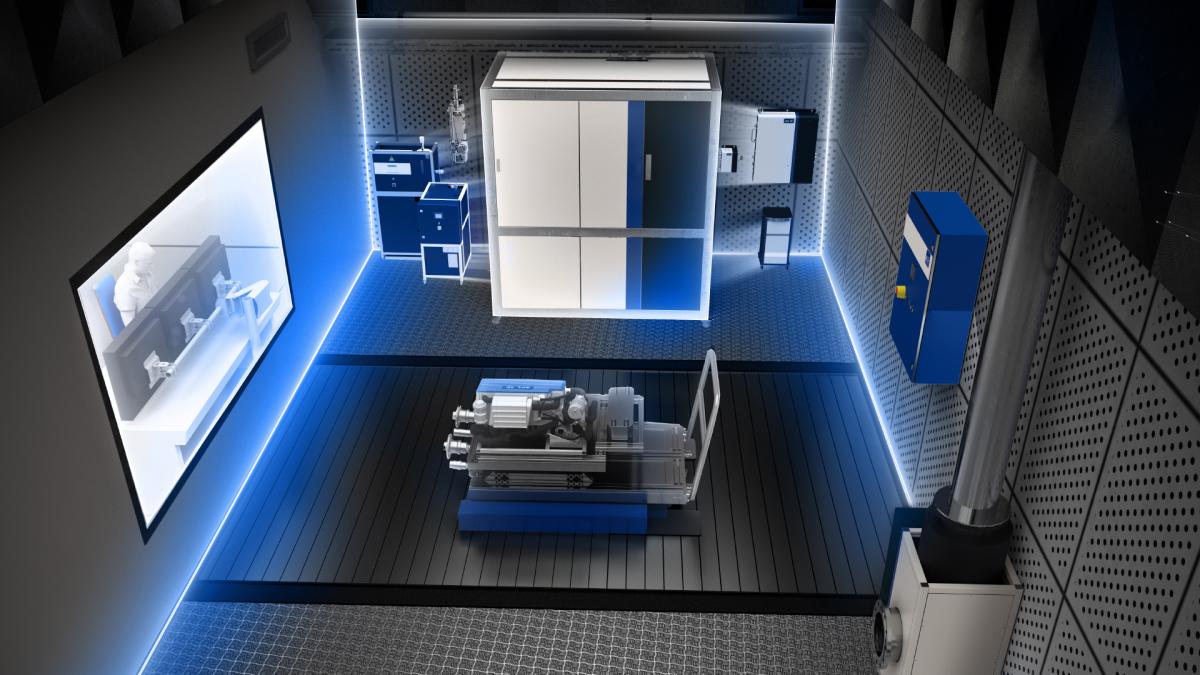
A stationary proton exchange membrane fuel cell program addressed backup power for a data center application. The development challenge was to convert automotive- derived fuel cell systems and components into a stationary power plant with coordinated mechanical, electrical, thermal, and control functions. AVL performed the power-plant design, hardware development, controls implementation, system integration, and testing. The architecture treated black-start as a complete-system function, requiring coordination between the fuel cell, stored energy, power electronics, cooling, fuel supply, and controls.
This approach moved the development focus beyond individual component performance and toward the behavior of the integrated backup-power system. The proof-of-concept demonstrator entered operation and achieved black-start capability. The customer value was a system-level development baseline that connected hardware, controls, and validation around the actual backup-power duty. The program also demonstrated how engineering methods and components originating in mobility applications can be translated into a stationary architecture when interfaces, operating states, and validation targets are redefined for the new application.
Key Points
- Accelerating Power Demand: Data center power demand is projected to reach nearly 150 GW by 2035 due to AI-driven growth, forcing operators to look for onsite, behind-the-meter generation.
- Complementary Fuel Cell Technologies: Solid Oxide Fuel Cells (SOFC) are ideal for continuous prime power due to high efficiency, while Proton Exchange Membrane Fuel Cells (PEMFC) provide fast-starting backup power.
- Coupled System Risks: Scaling fuel cells introduces complex, interconnected risks across subsystem boundaries (e.g., thermal expansion, pressure losses, media distribution) that cannot be solved by optimizing components in isolation.
- Model-Based Architecture: AVL uses Model-Based Systems Engineering (MBSE) and simulation tools to translate data center duty profiles into clear, robust system requirements before making hardware commitments.
- Optimized Module Performance: AVL’s engineering process achieves a temperature distribution below 5 °C and uniform media distribution of ±0.2%, maximizing module efficiency and reducing degradation.
Why are data center operators shifting toward behind-the-meter fuel cell power?
They are shifting to behind-the-meter systems because grid capacity is becoming constrained and connection times are lengthening. Onsite fuel cells allow operators to support new computing capacity immediately without relying on grid expansion.
What are the main challenges when scaling up fuel cell systems for data centers?
The main challenges include managing thermal expansion, sealing, and temperature uniformity, minimizing pressure losses, coordinating complex controls for backup power, and overcoming current supply chain and manufacturing limitations.
How does AVL help customers minimize financial and engineering risks before hardware development?
AVL uses system and process simulation (such as AVL CRUISE M), computational fluid dynamics (CFD), and finite element analysis (FEA) to evaluate system robustness and establish clear interfaces and acceptance criteria beforehand.
What technical benchmarks does AVL achieve in its SOFC stack module engineering?
AVL’s development process successfully keeps temperature variation below 5 °C and ensures a highly uniform media distribution of ±0.2% across the integrated stacks.