Who is Mimì?
Bieffe Project displayed Mimì at the Hydrogen Expo. The driveline is made up of fuel cells, batteries and supercaps
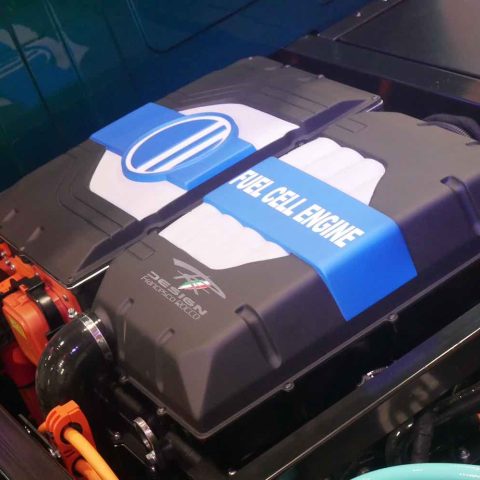
At the Hydrogen Expo in Piacenza, near Bieffe Project’s Mimì vehicle, we recognized a marking. NOVAC, don’t know it? Read more about it in this post, which highlights the potential of supercapacitors for sport cars and marine and off-highway applications as well.
What is the connection between NOVAC, Mimì and Bieffe Project?
Niccolò Barone, project manager of Bieffe Project, an engineering company that focuses with automotive design, mechanical and industrial design, CAE, design, manufacturing technologies and rapid prototyping, answers us. “It is an innovative vehicle, equipped with a unique powertrain. We conceived, designed and built it completely ourselves, in Modena, in the heart of the Italian Motor Valley. It is made up of a system of fuel cells, an electric motor, lithium batteries, and a layer of solid-state supercapacitors, which step in according to energy needs and the required engine speed.” These devices extend the life of the batteries and allow a much more efficient and reliable electrical performance, in an industrial application perspective, compared to the electric motor alone. ”Mimì,” Barone points out, “can overcome a 30% slope and reach a longer autonomy. The mechanism works roughly as follows: the fuel cell powers the electric. When the batteries (7.7 kWh at 70 Ah and 25 kWh at 210 Ah) are about to discharge, depending on demand, it provides to recharge them.”
Some vehicle specification
Mimì is a multipurpose vehicle, which is intended for use at public utilities, and claims a load capacity of up to two tonnes, a wheelbase of 2,000 mm, and an overhang of 1,220 mm at the front and 1,220 mm at the rear. With a footprint, measured in length, width and height, of 3,700 mm by 1,340 mm and 1,840 mm. In short, the dimensions of a mid-range car with the capacity of a true van. The GVW is 2,930 kilos. The autonomy, the touchstone of any electric machine, according to WLTP parameters, is 240 km in FCEV (Fuel Cell Electric Vehicle) mode and 230 km in BEV (Battery Electric Vehicle) mode.