Neptune Energy Pilot Phase II for lithium
Neptune Energy’s lithium project in the Altmark region has reached its next milestone. The company is working with Fraunhofer IEG in Pilot Phase II to optimise the adsorption process and test different adsorbent materials for future industrial use
Following an evaluation of various technologies for direct lithium extraction (DLE), Neptune Energy is working with Fraunhofer IEG in Pilot Phase II to optimise the adsorption process and test different adsorbent materials for future industrial use. Northern Saxony-Anhalt is home to one of the world’s largest project-related lithium resources, with proven reserves of 43 million tonnes of lithium carbonate equivalent (LCE). Lithium is dissolved in brine at depths between 3,000 and 4,000 metres. This brine is found in the fine pore spaces of rock. Neptune plans to produce the brine via wells and to extract the lithium using DLE.
In Collaboration with Fraunhofer IEG
“During Pilot Phase I last year, we investigated various DLE technologies available worldwide to assess their suitability for the conditions in the Altmark region. Following tests using ion-exchange and adsorption processes, adsorption technology proved to be the most promising for the conditions in the Altmark region. We now intend to further develop this process in collaboration with Fraunhofer IEG,” explains Joachim Sluet, Midstream Manager and head of pilot projects at Neptune Energy.
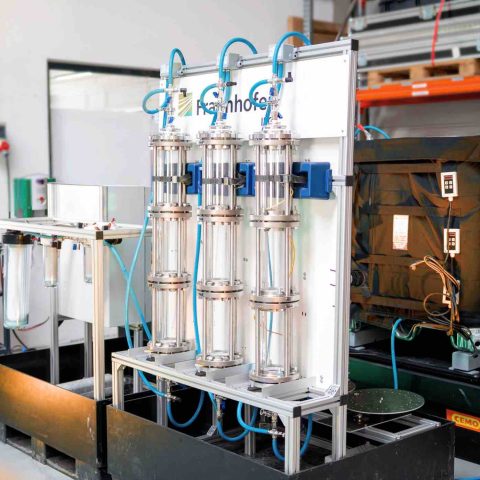
In Pilot Phase II, various adsorbent materials will be tested and evaluated over the coming months in a pilot unit for direct lithium extraction developed in collaboration with Fraunhofer IEG. Evonik Catalysts has been selected to supply the adsorbent material for the first test phase, having demonstrated its stability and performance in preliminary trials. In addition, Evonik is supporting the pilot programme by providing on-site application and process expertise. Adsorbents are designed to selectively adsorb (attract) lithium ions from the brine. The lithium is then desorbed (separated) from the adsorbent, producing a solution with a high lithium content: lithium chloride. This can be processed in further steps to produce battery-grade lithium carbonate or lithium hydroxide monohydrate – the raw material for the European battery and electric mobility industry.
The pilot unit, developed in collaboration with Fraunhofer IEG, enables the extraction of lithium in an oxygen-free environment, with a processing capacity of up to 1,000 litres of thermal water per day. Thanks to three adsorption columns operating simultaneously, the adsorption (attraction) and desorption (release) of the lithium ions can take place almost simultaneously.
Insights from Neptune
“The DLE pilot unit developed in collaboration with Fraunhofer IEG is providing us with important insights into selecting the optimal adsorbent material for the brine from the Altmark region. This brings us another step closer to industrial-scale lithium production from the Altmark region,” adds Axel Wenke, Director of New Energy & Business Development.
Through the Altmark Lithium Extraction Project (ALE), Neptune Energy aims to contribute to the domestic supply of critical raw materials and to the development of resilient European supply chains.
Commercial lithium production is set to begin gradually from 2030. The aim is to produce up to 25,000 tonnes of lithium carbonate equivalent (LCE) annually in the 2030s. This corresponds to the lithium required for the batteries of around 500,000 electric vehicles per year.
Lithium extraction in the Altmark
- In April 2024, the Saxony-Anhalt Mining Authority granted Neptune Energy approval to extract lithium in the Altmark region;
- In August 2025, Neptune Energy commissioned the internationally renowned and independent assessment company Sproule ERCE to determine the resource base for the project (CIM / NI43-101 standard);
- The experts defined resources of 43 million tonnes of lithium carbonate equivalent (LCE) in the Altmark. This means that northern Saxony-Anhalt is home to one of the largest project-related lithium resources in the world.
About Neptune Energy
Neptune Energy is a Germany’s commodities companies, with over 135 years of experience. Around 460 employees across many regions of Germany and at the head office in Hanover. Neptune Energy’s revenue for the 2025 financial year stood at 332 million euros (IFRS). Total annual production of gas and oil amounted to 5.9 million barrels of oil equivalent (boe).
About the Fraunhofer IEG
The Fraunhofer Institute for Energy Infrastructures and Geotechnologies (IEG) brings application-oriented research to its projects with industrial partners in order to develop mineral deposits in Germany, such as the lithium deposit in the Altmark region. The process engineers at IEG translate scientific findings into practical applications. Their remit covers plant engineering, ranging from simple test benches to the integration of new material or thermodynamic processes into existing large-scale plants. Neptune Energy has commissioned Fraunhofer IEG to carry out pilot-scale extraction trials specifically for the Altmark site.
What Is Direct Lithium Extraction (DLE)?
Direct Lithium Extraction refers to a group of process technologies designed to recover lithium directly from brines through selective separation steps.