Scaling biomethane: Almost 10 times more in less than 30 years
Capital is flowing into biomethane—but to deliver consistent returns, players will need to expand beyond single plants and professionalize the entire value chain. It's written in a report managed by McKinsey
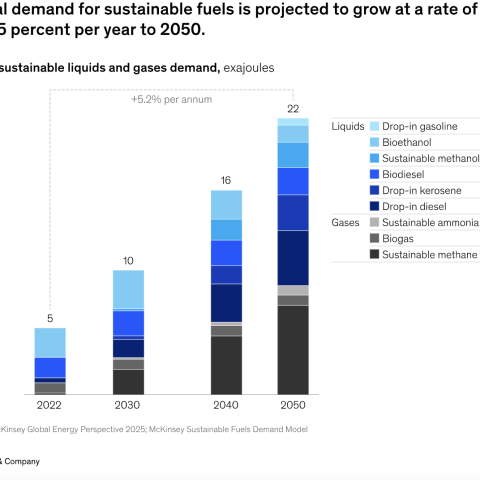
According to McKinsey, biogas and biomethane (RNGs) are going to rise from about 0.9 exajoules (EJ) in 2022 to nearly 8.0 EJ by 2050. The growth potential also spans multiple industries and regions. Over the coming decades, demand for biomethane is expected to expand steadily across power generation, buildings, industry, and transport.
While Europe and North America today account for roughly 60 percent of global demand, future growth is expected to come primarily from emerging markets, where rising energy demand coincides with large untapped waste and agricultural resources. China alone accounts for approximately 40 percent of the global rise in biomethane demand between 2023 and 2035, while India’s demand is projected to triple over the same period.
Feedstock Availabilty
Despite this strong growth outlook, the market still represents only a fraction of the available resource base. The current sustainable global feedstock availability could support roughly one trillion cubic meters (approximately 36 EJ) of biogas production annually, highlighting a substantial gap between today’s supply outlook and the underlying technical potential. Closing this gap is a central opportunity for the industry.
As the market expands and the scale of the opportunity becomes clearer, the biomethane sector is undergoing a profound structural shift. Sophisticated investors are entering the sector, challenging the traditional paradigm of a tariff-dependent industry and repositioning biomethane as a scalable and economically viable infrastructure asset class.
In the early phases of the industry—roughly from the late 1990s onward—biogas plants were typically developed and owned by small agricultural enterprises. Their primary objective was to produce electricity, using agricultural waste as feedstock. Economics were largely driven by the avoidance of electricity costs and supported by feed-in tariff schemes. However, these assets often faced structural limitations: relatively high feedstock costs (about €2 million per plant annually in many cases), limited scale, and a heavy reliance on policy incentives. As a result, returns were typically modest, and the model remained dependent on continued regulatory support.
Next step? Bio
Over the past few years, the industry has entered a second phase, marked by the development of traditional biomethane plants. Infrastructure investors and multi-utility companies began upgrading biogas into biomethane for injection into gas grids and for use in a growing range of end markets—particularly in transport fuels such as compressed biogas (bio-CNG) and liquefied biomethane (bio-LNG).
This evolution has opened new commercial pathways for renewable gas across several markets. However, the industry remains fragmented, and operational performance varies significantly across assets. Feedstock sourcing, for instance, is often driven by dedicated or ad hoc production of crops (such as straw) rather than by a structured strategy that optimizes feedstock mix, transportation distances, and methane yield per ton of biomass. Consequently, many plants operate with higher feedstock costs and suboptimal gas yields. Combined with heterogeneous plant configurations and operating practices, this results in business models that continue to rely heavily on regulatory incentives to deliver attractive returns.
The industry is now moving into a third phase, in which biomethane projects are developed as part of a professionalized energy infrastructure platform (table). Private equity funds and energy majors are building portfolios of plants and optimizing them through integrated feedstock logistics, industrialized operations, and diversified revenue streams. Additional sources of value are emerging, including biogenic CO₂ offtake and, where viable, the use of digestate as a soil improver. These platforms can benefit from lower feedstock costs (often closer to €1 million to €1.2 million per year per plant), higher operational efficiency, and greater revenue resilience.
Action Across Several Key Dimensions
- Network development models. Operators will determine the optimal balance between centralized injection points and more distributed models with multiple local entry points, reflecting the inherently decentralized nature of feedstock availability and biomethane production. While centralized hubs may offer economies of scale and simplified system management, distributed injection models can minimize transportation needs and better align with local production clusters. Balancing these trade-offs will necessitate a rethinking of traditional network planning, including capacity allocation, bidirectional flows, and targeted grid reinforcements.
- Regulatory frameworks. Operators will need to work within—and help shape—regulatory frameworks that support biomethane integration, including connection rules, cost allocation mechanisms, and incentive schemes. Clear and stable regulation will be critical to derisk investments, accelerate deployment, and avoid fragmentation across regions. Benchmarking across markets can provide valuable guidance, particularly in identifying best practices on connection cost sharing, tariff design, and mechanisms to incentivize both producers and network operators to scale biomethane efficiently.
- Operational and technical readiness. Upgrades to networks, metering systems, and gas quality management practices will be necessary to accommodate a growing number of injection points and more variable biomethane flows. This may include investments in compression, reverse-flow capabilities, and blending infrastructure, as well as enhanced monitoring and digital tools to ensure system stability. As injection patterns become more distributed and dynamic, operators would do well to improve their forecasting, data integration, and real-time system management capabilities.
What is McKinsey & Company?
McKinsey & Company (informally McKinsey or McK) is an American multinational strategy and management consulting firm that offers professional services to corporations, governments, and other organizations (Wikipedia).
What RNGs are?
Renewable natural gas (RNG) is a pipeline-quality gas that is fully interchangeable with conventional natural gas and thus can be used in natural gas vehicles. RNG is essentially biogas (the gaseous product of the decomposition of organic matter) that has been processed to purity standards (U.S. DOE)