European Commission approves up to €5.4 billion for hydrogen project
The European Commission has approved an Important Project of Common European Interest to support research and innovation and first industrial deployment in the hydrogen technology value chain. The project, called “IPCEI Hy2Tech” was jointly prepared and notified by fifteen Member States.
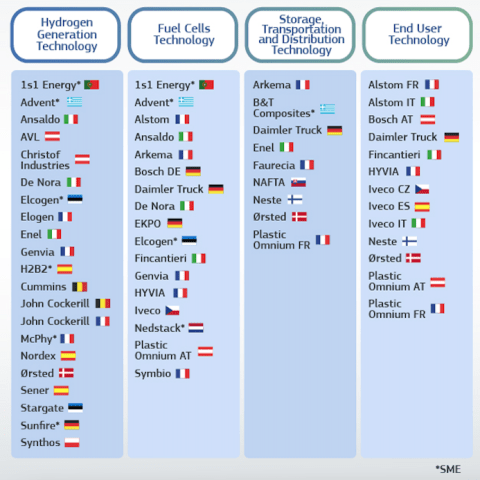
The European Commission has approved, under EU State aid rules, an Important Project of Common European Interest to support research and innovation and first industrial deployment in the hydrogen technology value chain. The project, called “IPCEI Hy2Tech” was jointly prepared and notified by fifteen Member States: Austria, Belgium, Czechia, Denmark, Estonia, Finland, France, Germany, Greece, Italy, Netherlands, Poland, Portugal, Slovakia and Spain.
The Member States will provide up to €5.4 billion in public funding, which is expected to unlock additional €8.8 billion in private investments. As part of this IPCEI, 35 companies with activities in one or more Member States, including small and medium-sized enterprises and start-ups, will participate in 41 projects.
Executive Vice-President Margrethe Vestager, in charge of competition policy, said: “Hydrogen has a huge potential going forward. It is an indispensable component for the diversification of energy sources and the green transition. Investing in such innovative technologies can however be risky for one Member State or one company alone. This is where State aid rules for IPCEI have a role to play. Today’s project is an example of truly ambitious European cooperation for a key common objective. It also shows how competition policy works hand in hand with breakthrough innovation.”
Commissioner for the internal market, Thierry Breton said: “Promoting hydrogen development and deployment will boost jobs and growth throughout Europe while contributing to our green and resilience agenda. It enables the clean transition of energy-intensive industries and increases our independence from fossil fuels. With this IPCEI, we see EU hydrogen production moving “from lab to fab”; and our industry turning technological mastery into commercial leadership. And of course, we are not only supporting hydrogen through funding. We have also made decisive progress on building partnerships through the Clean Hydrogen Alliance and are developing EU-wide rules for enabling the hydrogen market and creating dedicated infrastructure. Because we know what is at stake: Europe’s position as a leading region for the hydrogen industrial transformation.”
The IPCEI will cover a wide part of the hydrogen technology value chain, including the generation of hydrogen, fuel cells, storage, transportation and distribution of hydrogen, and end-users applications, in particular in the mobility sector. It is expected to contribute to the development of important technological breakthroughs, including new highly efficient electrode materials, more performant fuel cells, innovative transport technologies, among which first time roll out hydrogen mobility ones. The IPCEI is expected to create approximately 20.000 direct jobs.