Saudi Arabia Gets Renewable
Saudi Arabia to fall short of 130GW renewable energy target by 2030, says GlobalData
Just as the Strait of Hormuz is proving to be a literal bottleneck for European economies, Saudi Arabia is planning to boost renewable energy production. On the Arabian Peninsula, opportunities abound, from solar photovoltaic to green hydrogen production. Saudi Arabia aims to achieve a sustainable energy mix, with solar and nuclear power potentially accounting for more than half of its power supply by 2040.
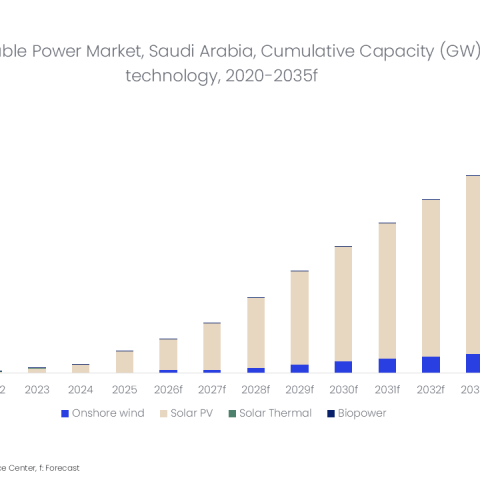
Saudi Arabia Vision 2030 has undergone several revisions, most recently in 2023, raising the target to achieve 130GW of renewable power capacity by 2030. However, with only 13GW renewable capacity achieved until 2025, the segment is expected to reach 74.2GW in 2030, falling well short of the target, according to GlobalData.
GlobalData’s latest report, “Saudi Arabia Power Market Trends and Analysis by Capacity, Generation, Transmission, Distribution, Regulations, Key Players and Forecast to 2035,” reveals that the country would need to add over 23GW a year to achieve its 130GW target. Saudi Arabia is self-sufficient in meeting its electricity requirements. With respect to energy security, it possesses one of the largest oil reserves in the world, which is used for power generation and export. Natural gas is also available for power generation, but none of the gas produced is exported.
According to GlobalData Arabia Needs Renewable Sources
Attaurrahman Ojindaram Saibasan, Power Analyst at GlobalData, comments: “Power consumption has been increasing at a rapid pace in the country due to a burgeoning economy and a growing population. A large amount of power is required for water desalination plants due to the low availability of naturally occurring groundwater. This has made it necessary for the country to use more oil for power generation, leaving less available for export. This is a development that Saudi Arabia cannot afford, and the government has therefore been focusing on increasing the share of non-oil fuels in its power mix.”
In October 2025, Saudi Arabia awarded 4.5GW of new solar and wind capacity in the sixth auction round of the National Renewable Energy Program (NREP). In September 2025, Saudi Power Procurement company (SPPC) announced the qualified bidders for the seventh round of Saudi Arabia’s NREP, which by January 2026 encompassed 5.3GW of combined solar and wind projects.
Saibasan adds: “Despite having support mechanisms such as net metering and renewable auctions, the country has not done enough to bolster its renewable capacity in line with its targets. Although the auctions have been fairly successful, the government needs to focus on establishing more purchase power agreements (PPAs) for large-scale renewable power plants.”
Saudi Arabia is strategically positioned to generate a considerable amount of electricity from solar power, given its high levels of solar irradiation. There has been moderate growth in onshore wind as well in the country. However, a massive overhaul is the need of the hour.
Saibasan concludes: “Despite its financial capability, the country’s overreliance on thermal power has stunted renewable growth. Its plan to convert the cancelled NEOM project into an AI and data center hub will create massive electricity demand, with offtake agreements for renewable power plants. However, the escalation of war in the Middle East may become a key challenge for making investment decisions. Policy makers need to overcome this challenge in order to achieve the country’s renewable target.”