Forklift industry mid-year review. A Report from Interact Analysis
According to the Interact Analysis forklift industry mid-year review, there is calm on the surface but turbulence beneath
At roughly 6% projected growth for 2026, the global forklift market appears healthy on the surface; yet beneath it, things may not be as they seem. Regional growth spreads have widened to more than 10%, technology adoption paths are diverging sharply, and geopolitical shocks, particularly the US-Iran conflict, have created an uneven energy cost burden that is reshaping investment decisions across customer segments. Review by Interact Analysis, a regular source for our market insights.
Drawing on data through August 2026 from our latest quarterly tracker, this article examines the underlying structural signals of the forklift market, and evaluates whether the industry’s moderate aggregate growth masks a fundamental realignment that could redefine competitive advantage over the next five years.
US, China and Europe
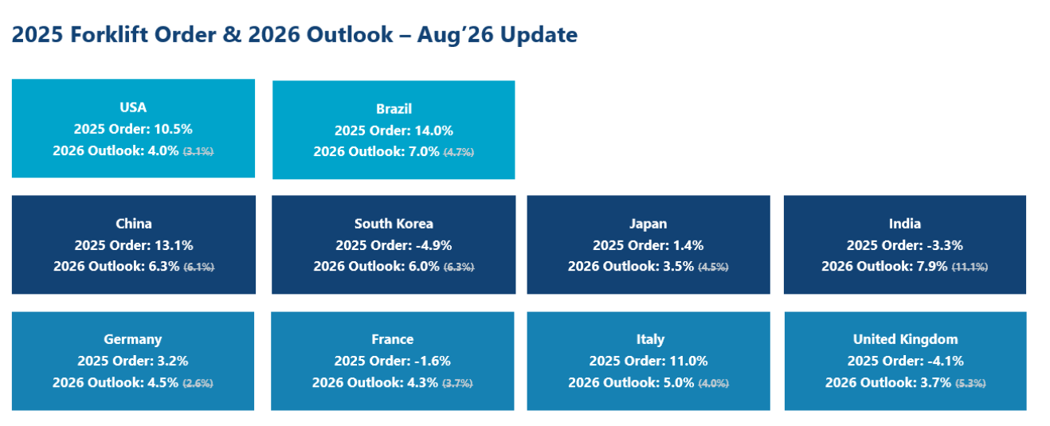
While the US recovery is certainly underway, it remains constrained by structural headwinds; manufacturing capacity utilization remains below its long‑term average and warehouse construction rates continue to fall. Federal reserve monetary policy is also weighing on capital expenditure as elevated interest rates continue to hinder investment. We project full‑year 2026 forklift order growth in the range of 3%-5%.
China continues to see stronger external demand relative to domestic conditions. Exports and high‑tech manufacturing support relatively robust demand, while domestic consumption, manufacturing PMI momentum, and capacity utilization have all softened. We expect forklift order growth of 6%–8% for the year. This would be down from the double‑digit pace of 2025 but still among the strongest of major economies.
Europe presents a more mixed picture. German manufacturing activity appears to have bottomed out in late 2025 and is now showing early signs of recovery in both industrial output and logistics leasing. We forecast full‑year order growth of roughly 4.5%, driven primarily by replacement demand and automation upgrades rather than new capacity expansion. Meanwhile, Spain continues to post the strongest growth in Europe, with expansion expected to approach 10% in 2026 after an 18.5% surge in 2025. This performance is largely attributable to its dynamic logistics sector and deep ties to Chinese export markets.
Japan, South Korea, India
In Japan, following a corrective rebound in internal combustion forklift sales in 2025, the outlook for lithium‑powered models remains constrained by rising energy costs and the weakening yen, which is eroding purchasing power. That said, semiconductor‑related manufacturing and warehouse construction continue to show resilience. Our 3.5% growth forecast broadly reflects this constrained yet stable trajectory.
South Korea stands out in terms of industrial momentum in 2026 because AI‑driven semiconductor investment has lifted manufacturing activity to a five‑year high, while warehouse development is shifting toward larger‑scale facilities. We project order growth of 6%, a strong rebound from the -4.9% contraction in 2025, signaling the start of a new structural expansion cycle.
India presents a different growth profile with a 2026 order outlook of 7.9% which is the highest among the top ten markets. India is recovering sharply from the -3.3% decline in 2025, however this headline recovery masks a deeper structural transition with rapid growth in electrification offsetting a fast phase‑out of internal combustion engine models.
Brazil’s 2026 outlook stands at 7.0%, down from 14.0% in 2025. Despite this, the country still ranks second among major markets and continues to lead in Latin America, with growth driven by agricultural logistics, mining‑related services, and manufacturing expansion. However the pace is expected to moderate from last year’s exceptionally high level as a result of base effects and capacity normalization.
Geopolitical undercurrents: the asymmetric impact of the Iran conflict
The outbreak of the Iran conflict has emerged as the single most important external variable of the year with an oil supply shortfall of approximately 1.5 million barrels per day triggering a sharp spike in energy prices (according to IEA data). However, the impact has been highly asymmetric: Asia, particularly Japan and South Korea, experienced the most pronounced manufacturing contraction and downward GDP revisions as a result of its heavy reliance on energy imports. In contrast, the United States, cushioned by domestic shale production, and Europe, supported by diversified supply sources and defense‑related infrastructure spending, faced comparatively milder effects.
This regional asymmetry translates directly into forklift demand dynamics. Internal combustion and standard warehouse trucks have seen sluggish order numbers, as a result of energy intensive sectors (chemicals, metals, industrial machinery, etc.) curtailing investment. In contrast, semiconductors, new energy, and defense supply chains, buoyed by AI‑related capital expenditure and industrial policies, continue to demonstrate resilient demand for lithium‑ion‑powered smart forklifts and automated logistics equipment. Additionally, elevated oil prices are also pushing up construction and raw material costs, prompting project delays and re‑evaluations, as well as giving rise to a moderate “bullwhip effect”, where companies scale back capital expenditure as a precaution, despite the fact that end‑user demand has not yet materially weakened.
Based on available data, the shock appears to have been largely absorbed by the second quarter with energy prices retreating approximately 20% from their peak. Whether or not a restocking cycle materializes in the third quarter will be a key indicator for assessing if the full‑year 6% growth target remains achievable. For forklift suppliers, this environment necessitates a reassessment of customer exposure across industries, prioritizing supply to structurally growing segments, while concurrently offering electrification alternatives to traditional energy‑intensive clients as a hedge against rising fuel costs.
Competitive Landscape Evolution: From Cost‑Performance to Ecosystem Capability
Globally, Chinese manufacturers now account for over half of global forklift shipments, leveraging cost advantages and a mature lithium‑ion battery supply chain to move upmarket into the mid‑to‑high tier segments. At the same time, incumbents such as Toyota, KION, and Jungheinrich have not stood still: their brand equity, global service networks, and software platform capabilities remain core defensive moats. Notably, the strength of these moats is diverging across segments. In standardized product categories such as Class 3.1 share gains by Chinese players have already materially eroded the pricing power of traditional brands. In contrast, in Class 1 and automated integration projects, the software capabilities and project delivery track records of established incumbents remain difficult for new entrants to match in the near term.
The market is increasingly bifurcating into two competitive arenas. In emerging economies and standardized product segments, price and scale remain the primary competitive levers. In mature high‑value markets, however, competition is shifting toward automated integration, energy solutions, fleet management software, and full‑lifecycle service capabilities.
Outlook for H2 2026: Expansion Persists, but the Margin for Error Narrows
The global forklift market remains on an expansionary trajectory, though the projected range for order growth has narrowed relative to the start of the year. For market participants, key indicators warranting close monitoring include port freight rates, dealer inventory levels, and the share of electric forklift orders. The performance of these indicators in the third quarter will largely determine whether full‑year growth settles at the upper or lower end of the forecast range.