Power Prove and the importance of load bank testing
Andrew Keith, division director of load bank manufacturer Power Prove, explains why low utilisation itself poses a technical risk to standby systems and how regular load bank testing helps ensure operational readiness
Andrew Keith, division director of load bank manufacturer Power Prove, explains the importance of load bank testing in preserving the efficiency of standby gensets. Recent infrastructure events across the UK have continued to highlight the importance of resilient power systems across critical services. In March 2025, the North Hyde substation experienced a major outage, according to the National Energy System Operator (NESO), resulting in the “loss of all supplies from the North Hyde 275kV substation.”
The incident disrupted Heathrow Airport operations and affected surrounding infrastructure, including transport networks, hospitals and local homes and businesses. Several data centres connected to the same network were able to maintain operations by relying on backup generators. It’s a clear reminder of how important standby power is in keeping essential services running during major grid failures.
Standby generators are commonly subjected to routine no-load or low-load start-up exercises to confirm that systems can switch on when required. While useful as a basic operational check, these short tests do not always reveal how a generator will perform under sustained demand conditions.
The risks of insufficient maintenance and testing
Generators are designed to operate within a defined load range where combustion temperatures and engine pressures remain stable. When diesel generators run at less than around 30 per cent of their rated load for extended periods, the risk increases. This tends to happen when systems are running well below their intended capacity over time, fuel combustion becomes less efficient, increasing the likelihood of carbon deposits forming within the engine and exhaust system.
One of the most common consequences is wet stacking: where unburned fuel, soot and residue accumulate in the exhaust due to incomplete combustion. Over time, wet stacking can reduce engine efficiency, increase maintenance requirements and contribute to long-term component wear.
Extended inactivity can also affect fuel stability, battery condition and electrical control systems. Because standby generators are only expected to operate during emergencies, faults may remain hidden until the system is suddenly required to support critical infrastructure during a power outage.
That can be a real challenge for sites where power continuity is essential. This includes hospitals, telecommunications infrastructure, manufacturing plants and industrial processing environments. In these settings, even short interruptions to backup power capability can have significant operational and financial consequences.
Events like the North Hyde outage show how important standby systems are during major disruptions. They also highlight a wider issue. Installing backup generation alone does not guarantee performance. Routine inspections might confirm a generator starts, but that does not always show how it will cope under sustained load. Without sufficient loading, underlying issues affecting cooling performance, voltage regulation or fuel delivery may remain undetected until the generator is operating under emergency conditions.
How load bank testing supports generator readiness
Load bank testing gives operators a clearer picture of how standby systems actually perform by applying a controlled electrical demand that mimics real-world use. By progressively increasing load, typically in stages up to full rated capacity, operators can evaluate alternator stability, voltage and frequency regulation, cooling system response and overall engine performance under continuous demand. This approach also helps to maintain combustion efficiency in diesel systems and reduce the risk of wet stacking associated with prolonged low-load operation.
For assets that spend most of their operational life on standby, periodic load bank testing provides an essential layer of assurance that cannot be achieved through routine exercise runs alone. It helps ensure that performance issues do not remain hidden until the point of failure, when the system is required to support critical infrastructure.
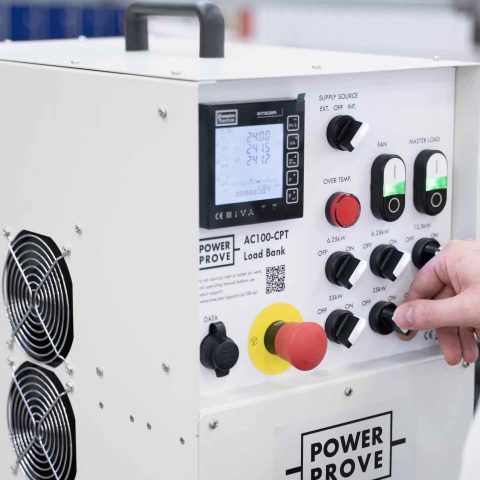
Power Prove provides AC load banks tailored to a range of standby power applications, helping operators validate generator performance under realistic site conditions and maintenance schedules.
About Power Prove
Based in Leicester, Power Prove is a team of engineers and manufacturing experts delivering the latest in load bank technology for purchase. They’re foused on a wide range of applications including; AC load banks for generator testing, DC load banks for battery discharge testing, integrated (radiator mounted) generator load banks and many other load bank testing and maintenance applications.
About North Hyde Substation Incident
According to government-owned energy system operator for Great Britain National Energy System Operator (NESO), “We’ve published our final report from the review into the North Hyde Substation outage which took place late on 20 March. The consequence was the loss of all supplies from North Hyde 275kV substation, impacting thousands of customers, including Heathrow Airport.
The impacts beyond Heathrow were significant, affecting essential services including road, rail and Hillingdon Hospital, as well as thousands of homes and businesses. Residents living near the substation had to be evacuated with some needing alternative accommodation. Three data centres lost power but were able to continue operations through the use of backup generators.
Customer restoration occurred within expected timeframes: by 12:24 all except two of the 66,919 domestic and commercial customers directly supplied by SSEN Distribution had power restored following the re-energisation of North Hyde 66KV. Information seen by this review suggests communication between SSEN Distribution and its domestic customers was effective and timely.
Using forensic analysis from both National Grid Electricity Transmission and London Fire Brigade, this review has seen evidence that a catastrophic failure on one of the transformer’s high voltage bushings at National Grid Electricity Transmission’s 275kV substation caused the transformer to catch fire.
This was most likely caused by moisture entering the bushing, causing an electrical fault. An elevated moisture reading in the bushing had been detected in oil samples taken in July 2018 but mitigating actions appropriate to its severity were not implemented. National Grid Electricity Transmission has since initiated an end-to-end review of its oil sampling process, with a view to ensuring that it is robust. In addition, they are undertaking a review and assurance exercise of all recorded oil samples to ensure all appropriate actions have been taken where required.
This review found that the design and configuration of Heathrow Airport’s private internal electrical distribution network meant that the loss of one of its three independent supply points would result in the loss of power to some of the airport’s operationally critical systems. Heathrow Airport Limited have a plan to deal with this which includes reconfiguring their internal electrical distribution network to take power from the other two supply points. The process to enact this is estimated to take 10-12 hours, according to Heathrow Airport Limited’s plans. This was less well-known by those outside the technical team within Heathrow Airport Limited, and it was not known to the energy companies.
The incident at North Hyde on 20 March caused a loss of supply to one of Heathrow Airport’s supply points. This resulted in the airport closing for most of 21 March so that its internal network could be reconfigured to take power from the two other operational supply points and to perform safety checks before reopening for some repositioning and repatriation flights. Heathrow reopened for some flights late on 21 March and was fully operational from 22 March.
The review also found that energy network operators are not generally aware whether customers connected to their networks are Critical National Infrastructure (CNI), and there is currently no explicit cross-sector requirement on CNI operators to ensure appropriate continuity of operations in response to power disruption. CNI facilities also have no priority within the electricity legal or regulatory framework. Work is underway, led by government, to identify and analyse cross-sector CNI interdependencies.”