Vanzetti Engineering’s ESK-IMO put to the test
Vanzetti Engineering presented the ESK-IMO for the marine and industrial market at an international event dedicated to LNG market trends, culminating in a demonstration at the company's headquarters
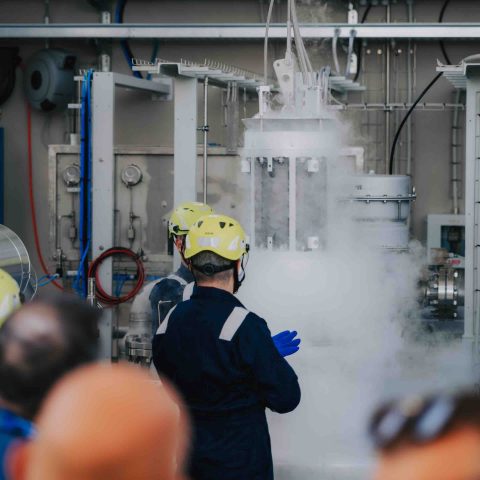
Because it is a live trial that we are about to tell you about. On 8 and 9 June, Vanzetti Engineering hosted an international event dedicated to LNG market trends and, in particular, to the development of Small-Scale LNG Terminals/FSRUs and bunkering. On this occasion, the company finalized testing of the new ESK-IMO extractable submersible cryogenic pump, a solution designed to meet the specific technological challenges of these segments.
Organised between the Langhe and the company’s headquarters in the province of Cuneo, a place well-know for the Barolo wine and the Alba truffles, the event brought together industrial partners, customers, national and international associations and foundations focused on LNG and international marine market research experts including Clarksons Research, providing an opportunity to discuss the prospects for liquefied natural gas and the technologies driving the energy transition.
“From the growth of global LNG trade and Small-Scale Terminals to the development of maritime bunkering and the spread of bio-LNG, the message to emerge from the event is very clear: the sector is undergoing a period of profound change and requires increasingly efficient, reliable and sustainability-oriented technologies. In this scenario, solutions such as the ESK-IMO extractable pump play a strategic role in supporting the next generation of LNG infrastructure worldwide,” commented Valeria Vanzetti Ghio, Managing Director of Vanzetti Engineering.
At HQ for a hands-on experience
The ESK-IMO series draws on the experience the company has built up with the ARTIKA submersible cryogenic pump, which has more than 1,500 units installed in marine applications, inheriting the reliability and quality of an already proven and well-established product.
The ESK-IMO pump has been designed to meet the operational requirements of small-scale terminals or for marine use as a Cargo/Stripping pump for tank emptying in the event of a malfunction and/or when maintenance is required on the main pumps.
The range comprises the ESK-IMO 230, ESK-IMO 300 and ESK-IMO 400 models, with capacities reaching 85, 300 and 550 m³/h respectively, covering the requirements of the main emerging LNG applications.
The distinguishing feature of the ESK-IMO series lies in the integration of an advanced validation process, based on a bench-test specifically designed and developed for this range, ensuring consistent and certified performance.
The shale gas factor
Turning to the application landscape and the global gas scenario: the shale gas revolution has redefined the world energy balance, positioning the United States as the leading global producer of natural gas and oil. Productive efficiency has increased enormously over the past ten years, with LNG output doubling while the number of operating wells has fallen sharply — from 1,500 to 100. The US LNG export capacity, currently around 150 million tonnes per year, could reach 250–270 million tonnes by 2031.
All of this is taking place against a backdrop of exponential growth in consumption, with artificial intelligence emerging as the primary driver of energy demand. The proliferation of data centres is requiring ever-greater quantities of energy, prompting technology operators to seek dedicated and reliable supply sources — opening new prospects for natural gas as well.
The significance of this scenario is underscored by global LNG trade, which rose from around 240 million tonnes in 2015 to more than 440 million in 2024, a figure that highlights the need for long-term planning to mitigate market volatility.
Small-scale LNG terminals
The large volumes of LNG that will become available should favour a range of applications, including small-scale LNG terminals — increasingly strategic infrastructures for making liquefied gas accessible to ports, industries and areas not served by major pipeline networks.
The event highlighted how the number of small-scale terminals continues to grow across many regions of the world, driven by the need to develop more flexible and resilient energy systems. According to data presented by the International Gas Union, around 40% of liquefaction plants currently under construction worldwide fall into the small-scale category, with capacities of up to 3 million tonnes per year.
The growth of small-scale terminals is driven not only by lower capital costs, but also by significantly shorter permitting and construction timelines compared with conventional terminals. The most promising prospects involve emerging markets such as India, Indonesia and several African countries, where urbanisation and population growth are rapidly increasing energy demand.
In parallel, Floating Storage and Regasification Units (FSRUs) are playing an increasingly strategic role in ensuring energy flexibility and security, particularly in Europe, where they have helped to diversify supplies following the reduction in flows from Russia. Among the most innovative technological aspects to emerge at the event was the growing interest in recovering so-called “cold energy” generated during LNG regasification processes. This energy can be put to use in a variety of industrial applications, from dry ice production and air separation to the cooling of data centres located in proximity to terminals.
The growth of LNG bunkering
Another central theme of the discussions was the future of LNG bunkering, regarded by many operators as one of the primary drivers of liquefied gas demand growth over the next decade. Around 60% of new orders for vessels powered by alternative fuels involve LNG solutions, confirming the central role of this fuel in the decarbonisation of maritime transport — further supported by the evolving international regulatory framework and the emissions reduction targets set by the IMO and European policies.
The analyses presented confirm the consolidation of LNG as a marine fuel: more than 1,500 vessels are already LNG fuel-capable, with projections exceeding 3,500 units by 2030, while the dedicated bunkering fleet is set to reach 80 units by 2028.
The adoption of new bunkering guidelines and the completion of dedicated infrastructure are expected to further accelerate the uptake of LNG in maritime transport. There are, however, elements of uncertainty, linked both to future global carbon pricing policies and to geopolitical tensions affecting strategic areas such as the Strait of Hormuz, which have the potential to disrupt trade routes and increase transport costs.
Heavy transport and bio-LNG
In the Italian context, the market is benefiting from the expansion of coastal infrastructure and storage depots, with the heavy transport sector emerging as the primary driver for the deployment of Small-Scale LNG Terminals. This segment, which accounts for around 70% of sector consumption through a fleet of 5,300 vehicles and 177 refuelling stations, represents the beating heart of this application today.
Vanzetti Engineering champions bio-LNG as a key solution for decarbonising freight transport in an immediately practicable form, building on existing infrastructure networks and technologies. The effectiveness of this transition depends, however, on a more harmonized European regulatory framework; in this regard, the German model represents a fundamental benchmark, having already implemented targeted incentives that are accelerating the adoption of bio-LNG-powered vehicles. This is essentially what industry leaders called for at the recent IAA Media Summit.
The ESK-IMO range at a glance
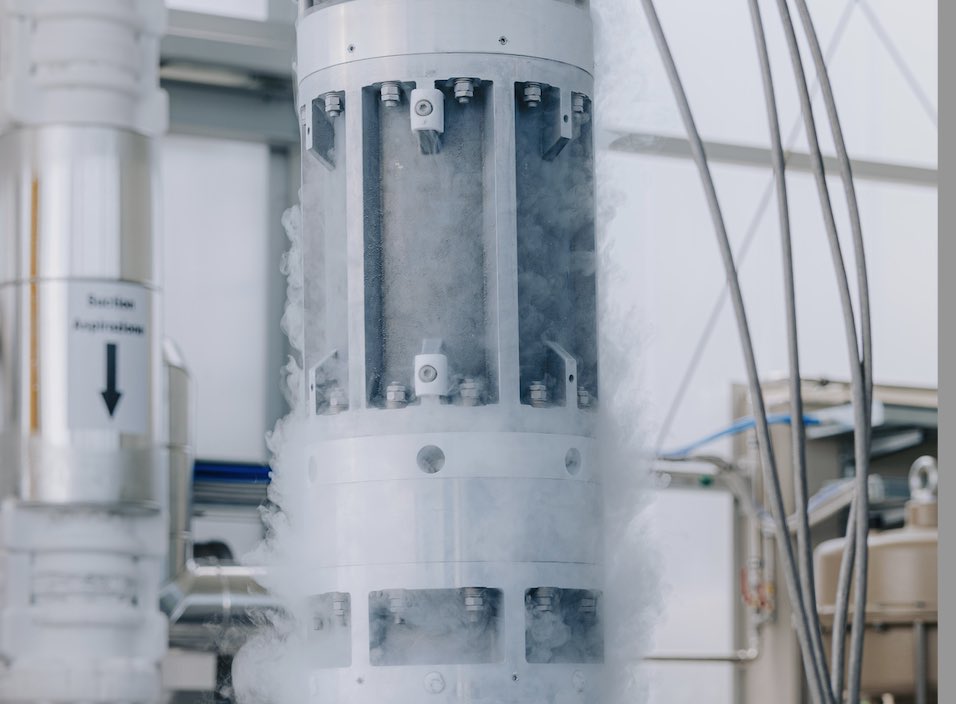
- ESK-IMO 230 capacity: 85 m³/h
- ESK-IMO 300 capacity: 300 m³/h
- ESK-IMO 400 capacity: 550 m³/h
What is shale gas?
The term refers to natural gas — predominantly methane — found within sedimentary metamorphic rocks known as shales or argillites, extracted by means of specific hydraulic fracturing techniques.
What is a Floating Storage and Regasification Unit (FSRU)?
FSRUs are vessels — floating units capable of transporting, storing and regasifying liquefied natural gas (LNG) on board.
And Bunkering?
Bunkering is the supply of fuel and lubricants to vessels. It is generally carried out either ship-to-ship, where one vessel acts as a terminal while the other is moored alongside, or via a stern line connection.