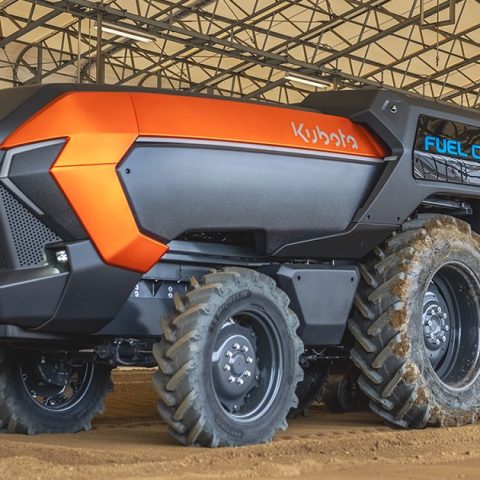
Kubota fuel cell tractor concept
Kubota Corporation exhibited a concept model of an autonomous fuel cell tractor at the event “Hydrogen Energy Park!!,” at the Expo 2025 Osaka Kansai
The curtain is set to rise on the Osaka Expo, in Japan, in about two weeks. A city that, on these pages, predominantly takes on two meanings: Kubota and Yanmar (in strictly alphabetical order). And it is Kubota that has pulled off a masterstroke, sending a signal to public opinion particularly attentive to climatic threats and to the off-highway industry.
Kubota has invested in what some deem to be ephemeral: a fuel cell tractor
The latter has shown itself to be so skeptical of fuel cells that it hasn’t even mentioned them. There have been a few mentions of the internal combustion engine, but without much conviction. Kubota, however, presented a small tractor with a solid polymer fuel cell with a power equivalent to a 100-horsepower diesel engine tractor.
The “magic moment” happened at the event “Hydrogen Energy Park!!,” held over four days from Monday, September 22 to Thursday, September 25 at the Expo 2025 Osaka Kansai. According to the Kubota official: “In addition to electrification using batteries, we are promoting all-round research and development toward decarbonization, such as engines that use hydrogen, biofuels, and synthetic fuels.
In particular, since large agricultural machinery requires high output and long operating hours, the introduction of hydrogen fuel cells, which offer high energy density, is considered one of the most promising solutions for achieving the required performance while also reducing environmental impact.
Building on our long-standing expertise in agricultural machinery development, we have developed an autonomous fuel cell tractor that integrates technologies for configuring and controlling hydrogen fuel cell systems optimized for tractors, along with autonomous driving and remote operation capabilities.
The concept behind this model is to simultaneously achieve environmental sustainability, operational efficiency, and labor saving. Since only water is discharged during operation, it is environmentally friendly, and is also designed for operation without operators onboard via autonomous driving and remote control, and exhibits the functions and values required for next-generation agricultural machinery in a concrete form.”