Diemmax for the MARIN FENDER Prototype
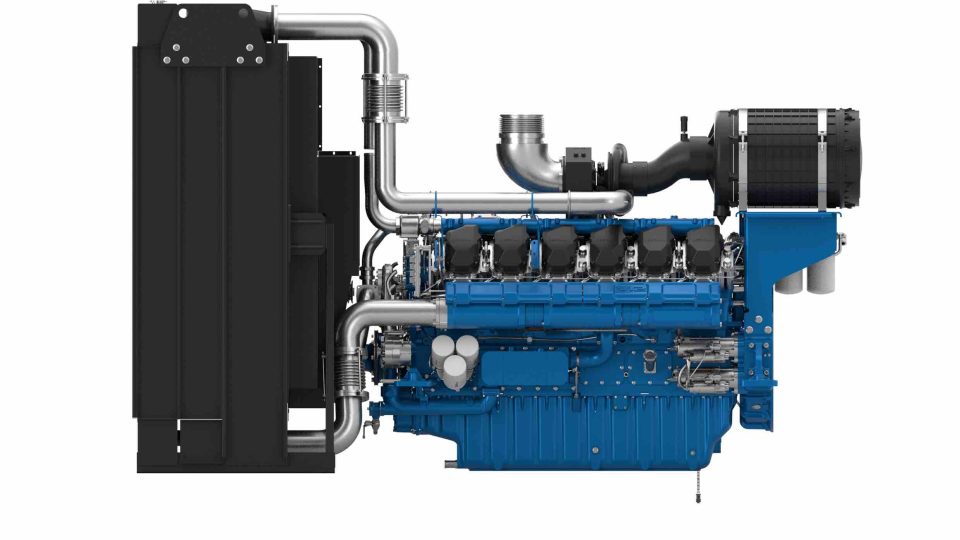
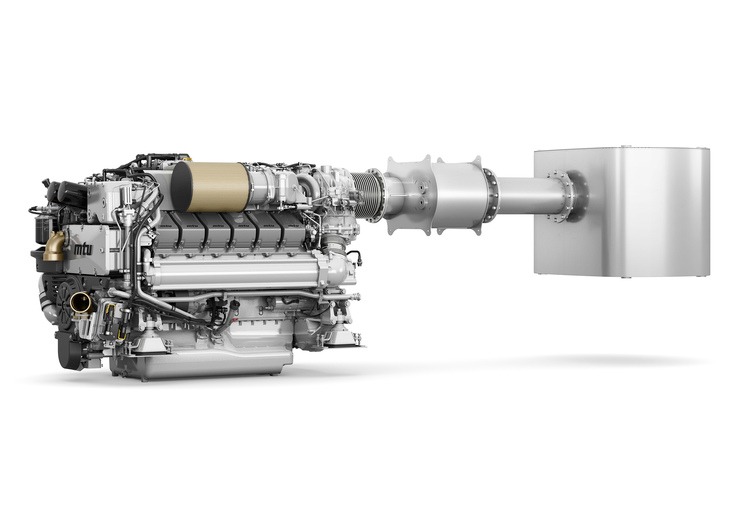
For the propulsion of the FENDER prototypes, MARIN (Maritime Research Institute Netherlands) selected the DIEMMAX marine 6-260 — our inline-6 marine diesel
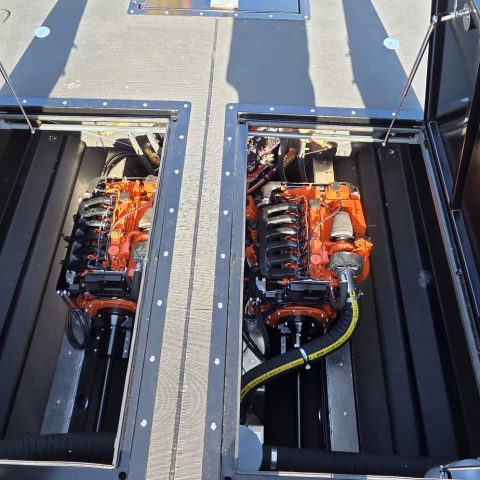
MARIN (Maritime Research Institute Netherlands) — the Maritime Research Institute Netherlands — developed in collaboration with the Dutch Ministry of Defence to build and deploy affordable, scalable USVs for naval operations.
For the propulsion of the FENDER prototypes, MARIN (Maritime Research Institute Netherlands) selected the DIEMMAX marine 6-260 — inline-6 marine diesel. The reason, in their own words: “sufficient power for North Sea operations, reduced vulnerability compared to outboard solutions, and the ability to communicate directly with the engine via our own electronic control unit.”
Diemmax and MARIN for the Unmanned Surface Vessel
That story begins when, in 2024, the Ministry of Defence asks MARIN to help develop an ecosystem for the scalable production of affordable unmanned surface vessels (USVs). The Royal Netherlands Navy is aware of rising international tensions, as well as increasing labour shortages. That is why it is developing new operational concepts in which unmanned units work together effectively and scalably with manned units. The aim is to innovate through short-cycle learning using new production methods, modular application of technology and collaboration with non-traditional partners. Project SeaRush is now a reality.
A team of specialists from MARIN’s Defence and Performance at Sea departments is taking on this challenge and has decided to investigate whether a full-scale USV can be 3D-printed. According to their assessment, this should be achievable quickly. Moreover, the material is easily recyclable for a subsequent iteration and the printing process is easily adaptable. Using a search tool they developed themselves, the team identified which companies, techniques and materials within the Netherlands are relevant for the production of unmanned systems. They turned to CEAD in Delft, which manufactures large-format 3D printers, and to IMPACD Boats in Woudsend, Friesland, with extensive experience in 3D printing, engineering and the outfitting of vessels.
Bathtub
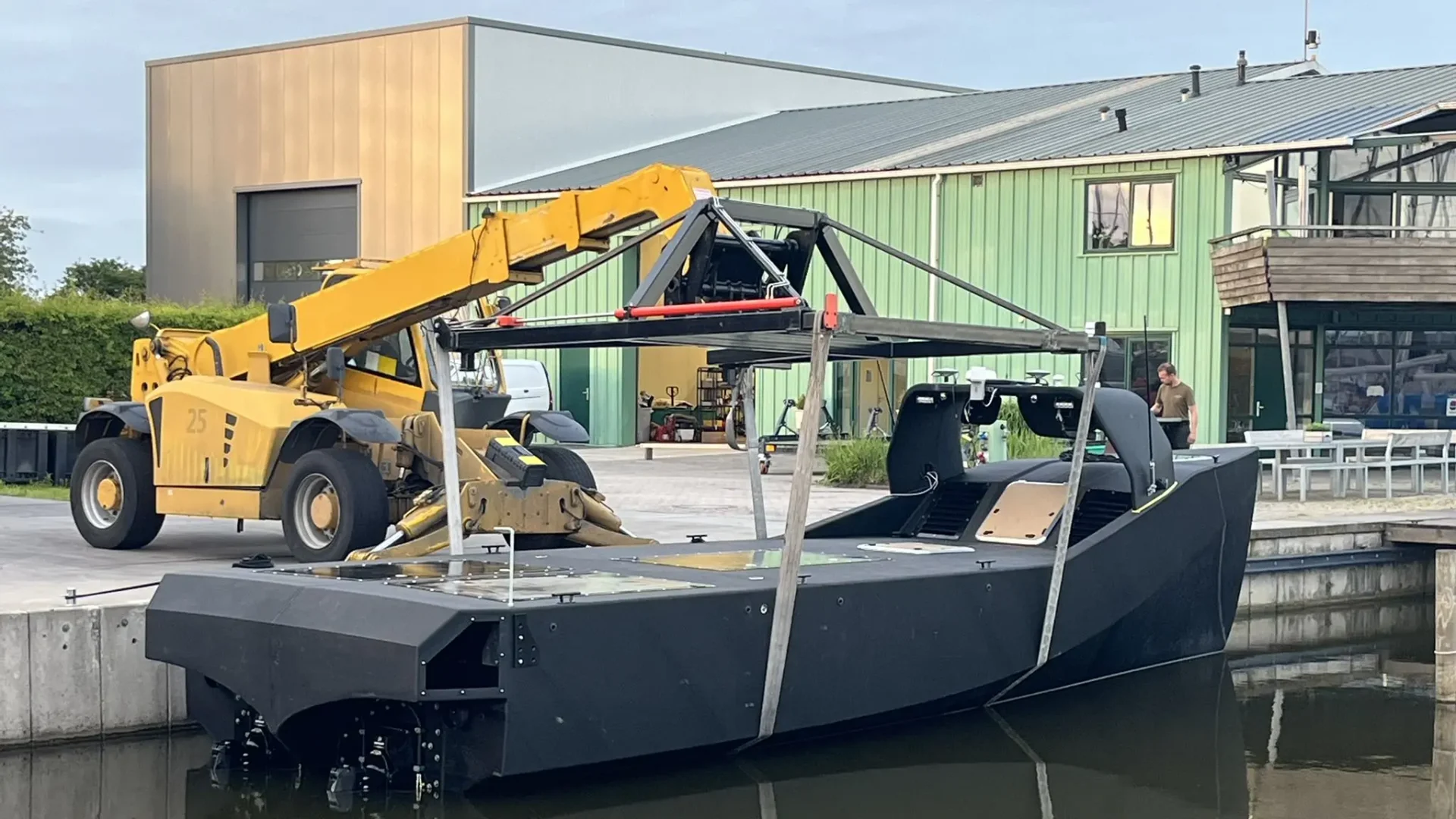
Incidentally, the first model is purely a test to assess whether 3D printing is even an option. But that’s proving to be quite a challenge. For instance, the printer has stopped twice, halfway through a print job. What do you do then? Start again? Print the remaining part separately and weld it on? Just carry on printing from where you left off? It turns out to be the last and most difficult option, in which the attachment point has to be brought back up to temperature. But on 9 July 2025, the ‘bathtub’, as the model is affectionately known, is indeed on display on the pier at Den Helder during a Royal Netherlands Navy roadshow. Meanwhile, preparations for a second model that can actually sail are already in full swing. The outboard motor for this comes from Honda, which, thanks to its interface with the control system from the Italian firm UltraFlex, can also be operated externally.
That sort of thing. Part of our remit is not to do anything on autopilot. That makes it fun and challenging, but it also eats up time. On the other hand, you also come across unexpected opportunities. For example: traditionally, when designing a hull, you work with transverse frames. With 3D printing, you can print box frames along the entire length of the hull. You can then build lighter structures, alter the dimensions and use those longitudinal frames as cable ducts.’In January 2026, SeaRush’s deployment will ramp up significantly.
During the Maritime Uncrewed Sea Trials (MUST) in June on the North Sea, the Ministry of Defence aims to demonstrate how multiple unmanned USVs can operate in a fleet formation alongside manned units. What follows is a race against the clock in which all those involved, both within and outside MARIN, are pushing the boundaries. At MARIN, Just Settels and Arnout Anneveld, are responsible for ensuring that the two new prototypes, the FENDER 1 and 2, cross the finish line on time in June. Just: “We’re constantly dealing with exceptions to the rules, pushing boundaries. And then you run into all sorts of obstacles. Because where and how, for example, do you insure an USV like that? How do you arrange permission for transmission frequencies? How do you tackle all the regulations you have to comply with to be allowed to sail unmanned?”
Arnout adds: “It’s very inspiring to see how many new doors we’ve opened during this process. All sorts of things we didn’t know about or do before. You explore a market, you collaborate with companies you didn’t know before, you create tangible things together. That’s going to open up so many possibilities for MARIN in the future.”
Printed on IMPACD
The two FENDERs are being printed on IMPACD Boats’ brand-new printer, which has a print range of 10 metres. But it then transpired that the prototypes needed to be longer – first 11 metres, and eventually even 11.5 metres. The question was whether the printer could be extended to a range of 12 metres. Marieke de Boer of IMPACD Boats: “You need that flexibility to see innovation projects like this through to a successful conclusion. Believing that it can be done, you tackle each challenge as it comes. Everything is a learning experience. Can’t we get a spray booth? Then we’ll build one ourselves. Not allowed to transport the model? Then someone simply gets a lorry driving licence. Printing material not delivered? Then we switch to a different material within three days, and suddenly we can save 30 hours on ten days of printing for a model. That mindset – of pushing the boundaries and not accepting the status quo as collaborative partners – is something I’m proud of.”
About Software
For the software side of SeaRush, we need to go back in time a little. In 2022, the KNOWONE knowledge development programme will commence, in which MARIN is investigating on behalf of the Ministry of Defence how USVs can sail in formation autonomously and follow a manoeuvring manned vessel. That research is being translated into software to demonstrate this on a simulator.
Egbert Ypma, senior project manager at MARIN, helped the Ministry of Defence optimise the software: “Using a mobile simulator, we engaged in discussions with future operators on site. OK, you want to do more and more with fewer people. So how do you envisage that interaction between manned and unmanned units? How do you want to deploy them? What do you need for the future? That, combined with the geopolitical changes in the world, accelerated the Ministry of Defence’s thinking on the applications of USVs and thus also the demand for USV prototypes for practical testing. And that brings us back to SeaRush, where the KNOWONE software needs to migrate to a new software architecture for use on board USVs.”
Olivier Schnitzeler is the technical project manager at MARIN for that software architecture and for the test environment in which his team integrates hardware from various suppliers. He is still amazed at how much they have achieved in such a short time: “In September 2025, I attended a demonstration in Portugal. There, I spoke to a group demonstrating the kind of platform we had in mind. They had been working on it for three years with a team of 40 software engineers, supported by 60 people who handled the engineering of the vessel itself. I told them that I also wanted to give a demonstration next year with two USVs, but that we currently had nothing and were a team of seven. ‘Good luck,’ was the reply.”
Plug & Play Test setup
Those challenges start right here on our own premises, because where within MARIN can you quickly get to work with experimental software and hardware without compromising cyber security? Nowhere. So the team operates in a ‘gap’, somewhere on the fourth floor of Building B, separate from all MARIN systems. They are supported by four software engineers from Eagle Science in Amsterdam. The holy grail here is to design a plug & play test setup into which you can plug in and remove various components and sensors. For example, an engine.
SeaRush is switching from the Honda outboard motor to an inboard motor from Diemmax Marine, a Dutch manufacturer based in Kootwijkerbroek: the Diemmax 6-260. This has the necessary power for exercises in the North Sea, is less vulnerable, and also offers the possibility of communicating directly with the engine via the electronic control unit developed by Diemmax itself. Furthermore, Diemmax also supplies its own autonomous control system, which is already in use with several defence partners.
Olivier: “To integrate the engine, we have set up two microcontrollers. One for control, so that we can communicate with the engine, and one to emulate the engine. We combine these with our data from xSimulation, including information on the engine’s RPM, the rudder angle, the speed through the water, and so on. This allows us to simulate an entire boat, including all the data that such a boat generates. But the real strength is that if we load different software onto the microcontroller and start up a boat with a different engine in xSimulation, we can test a different boat in no time.”